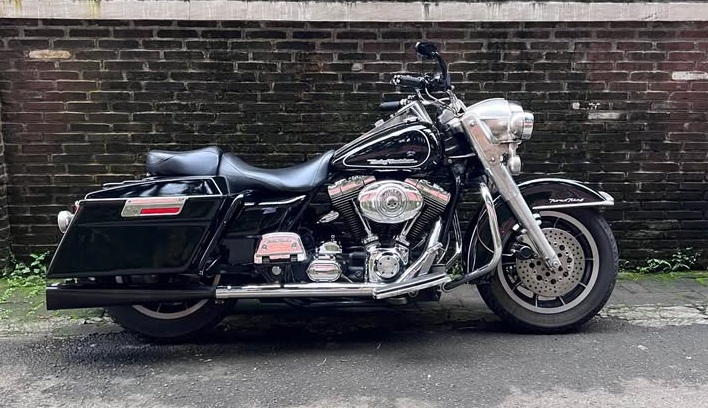
The 1999 – 2006 Harley-Davidson Road King (FLHR) Twin Cam 88 represents one of the most significant transitional eras in the history of American heavy-weight touring motorcycles. As the flagship cruiser of the touring family, the Road King combines the nostalgic styling of the 1960s FLH models with modern engineering that was revolutionary at the turn of the millennium. This specific generation is defined by the introduction of the Twin Cam 88 engine, which replaced the long-running Evolution motor, marking the company’s first clean-sheet big-twin engine design since 1936. For riders in the United States and Canada, this model became the gold standard for cross-country travel, offering a blend of highway capability and stripped-down cruiser aesthetics.
The Heart of the Machine: Twin Cam 88 Engine
The defining characteristic of this generation is the power plant. The 1999 – 2006 Harley-Davidson Road King (FLHR) Twin Cam 88 utilizes an air-cooled, 45-degree V-Twin engine with a displacement of 1,450 cc (88 cubic inches). Unlike its predecessor, which used a single camshaft, the Twin Cam 88 features two chain-driven cams—one for each cylinder. This configuration allowed engineers to improve valve train geometry, resulting in better intake and exhaust flow.
The engine produces significantly more torque and horsepower than the previous generation, making it ideal for the long, open highways found across North America, from the Interstate Highway System in the US to the Trans-Canada Highway. The “88” refers to the cubic inch displacement, a significant jump from the 80 cubic inches (1340 cc) of the Evolution era. This engine is mated to a 5-speed manual transmission, which provides a robust and mechanical feel that purists appreciate.
Differences Between the Road King Twin Cam 88 and the Evolution Model
To understand the importance of the 1999 – 2006 Harley-Davidson Road King (FLHR) Twin Cam 88, one must look at how it improved upon the Evolution model (1994–1998). While the silhouette remained largely unchanged, the engineering underneath was vastly different.
-
Engine Architecture: The Evolution engine used a single cam gear design which limited high-RPM performance and valve lift. The Twin Cam 88 utilized dual cams, allowing for steeper cam lobes and better breathing.
-
Structural Integrity: The Twin Cam engine was designed to be structurally stronger. The transmission case was bolted directly to the rear of the engine, creating a stiffer driveline that reduced flex under heavy acceleration.
-
Cooling and Oil Circulation: The Twin Cam 88 introduced a new internal oil pump design that scavenged oil more efficiently and reduced operating temperatures compared to the Evolution, which was critical for reliability during summer touring seasons.
-
Vibration Damping: While both used rubber-mounting systems, the Twin Cam era refined the isolation mounts to better handle the increased reciprocating mass of the larger pistons.
Chassis and Touring Capability
The chassis of the 1999 – 2006 Harley-Davidson Road King (FLHR) Twin Cam 88 is built on the FL touring frame. This heavy-duty steel cradle frame is designed to support the weight of a rider, a passenger, and fully loaded saddlebags. The suspension setup consists of 41mm telescopic front forks and air-adjustable rear shocks. The air suspension allows riders to adjust the preload based on the load carried, a feature highly valued by touring enthusiasts who alternate between solo riding and two-up trips.
Visually, the bike retains the “King of the Road” persona. It features a large, detachable windshield, a massive chrome “Hiawatha” headlamp nacelle that harkens back to the earliest Duo-Glides, and color-matched hard saddlebags. The instrument cluster is tank-mounted, keeping the handlebars clean and uncluttered. In the US and Canadian markets, the speedometer face differs slightly in primary units (mph vs. km/h), but the layout remains identical.
Evolution of the Model (1999–2006)
Throughout this seven-year production run, the 1999 – 2006 Harley-Davidson Road King (FLHR) Twin Cam 88 saw several incremental updates that improved reliability and performance:
-
1999: Launch of the Twin Cam 88 engine with a carburetor or optional Magneti Marelli Electronic Fuel Injection (EFI).
-
2000: Upgrades to the braking system with new calipers and rotors for better stopping power.
-
2002: A pivotal year where the optional fuel injection system switched from Magneti Marelli to the superior Delphi EFI system. This improved throttle response, cold starting, and tuning capabilities.
-
2002: Introduction of a wider 1-inch rear axle and stronger swingarm bearings to improve high-speed stability.
-
2004: The rear tire width was increased from a narrow MT90 to a slightly wider MU85 size, offering better load capacity and longevity.
Market Reception in USA and Canada
In North America, the Road King occupies a unique niche. It serves as a bridge between the stripped-down Softail cruisers and the fully faired Electra Glides. The 1999 – 2006 Harley-Davidson Road King (FLHR) Twin Cam 88 became a favorite for police departments across the United States and Canada due to its maneuverability at low speeds and comfort during long shifts. The Twin Cam 88 era is often looked back upon fondly by mechanics and riders for its mechanical simplicity before the introduction of more complex electronics and the 96 cubic inch engines in 2007.
| General | |
| Brand | Harley-Davidson |
| Model | Road King |
| Model Class | FLHR / FLHRI (Injected) |
| Model Year | 1999 – 2006 |
| Type | Grand American Touring / Cruiser |
| Maximum mass | 1,259 lb. (GVWR) |
| Maximum passengers | 2 |
| Performance | |
| Max. power | 67 Hp (50 Kw) / 5200 RPM |
| Max. torque | 86 ft-lb (116 N•m) / 3500 RPM |
| Min. turn diameter | ~18 ft |
| Top designed speed | 109 mph (175 km/h) |
| Size | |
| Length | 93.7 in. (2380 mm) |
| Width | 34.5 in. (876 mm) |
| Height | 55.0 in. (1397 mm) |
| Wheelbase | 63.5 in. (1613 mm) |
| Seat height | 27.3 in. (693 mm) – Laden |
| Ground clearance | 5.1 in. (130 mm) |
| Curb weight | 723 lb. (328 kg) Dry / 760 lb. (345 kg) Wet |
| Engine | |
| Type | Air-cooled, Twin Cam 88® (V-Twin) |
| Displacement | 1450 cc (88 cu. in.) |
| Bore × Stroke | 3.75 in. × 4.00 in. (95.3 mm × 101.6 mm) |
| Compression ratio | 8.9:1 |
| Starting system | Electric starter |
| Fuel supplying system | 40mm Keihin CV Carburetor or ESPFI (Electronic Sequential Port Fuel Injection) |
| Ignition control system | Single-fire, non-wasted, map-controlled spark ignition |
| Lubricating system | Dry sump, internal gerotor pump |
| Oil capacity | 4.0 qt (3.8 L) |
| Engine oil type | SAE 20W-50 Harley-Davidson 360 |
| Coolant capacity | N/A (Air Cooled) |
| Coolant type | N/A |
| Idle speed | 950 RPM – 1050 RPM |
| Transmission | |
| Transmission type | 5-speed, manual gear shift |
| Clutch type | Wet, multi-plate (9 plate) |
| Driving system | Belt drive (Carbon fiber reinforced) |
| Primary reduction ratio | 1.54 (Chain) |
| Final reduction ratio | 3.15 |
| Gear ratio | 1st: 10.11; 2nd: 6.96; 3rd: 4.95; 4th: 3.86; 5th: 3.15 |
| Chassis | |
| Tire size | Front: MT90B16 72H; Rear: MT90B16 74H (MU85B16 after 2004) |
| Rim size | Front: 16 x 3.0 in; Rear: 16 x 3.0 in |
| Capacity of fuel tank | 5.0 gal (18.9 L) |
| Fuel consumption | Approx. 39 – 46 MPG (Combined) |
| Electric | |
| Battery | 12V, Sealed Lead Acid |
| Headlight | 7-inch Hiawatha style, Halogen H4 55/60W |
| Position Light | Fender tip lights (Front/Rear) |
| Turning light | Single filament bulb (Self-canceling system) |
| Tail light | Standard 1157 dual filament |
| Front fog light | Dual Passing Lamps (Spotlights) 35W |
| Shock Absorbers | |
| Front travel | 4.6 in (117 mm) |
| Front rebound damping | Fixed |
| Front compression damping | Fixed |
| Rear travel | 3.0 in (76 mm) |
| Rear rebound damping | Fixed |
| Rear compression damping | Air adjustable |
| Rear spring preload | Air adjustable (0-50 psi max depending on load) |