Of course. Here is a full article about the 2000 – 2006 Harley Davidson Fat Boy, written in the requested style and format.
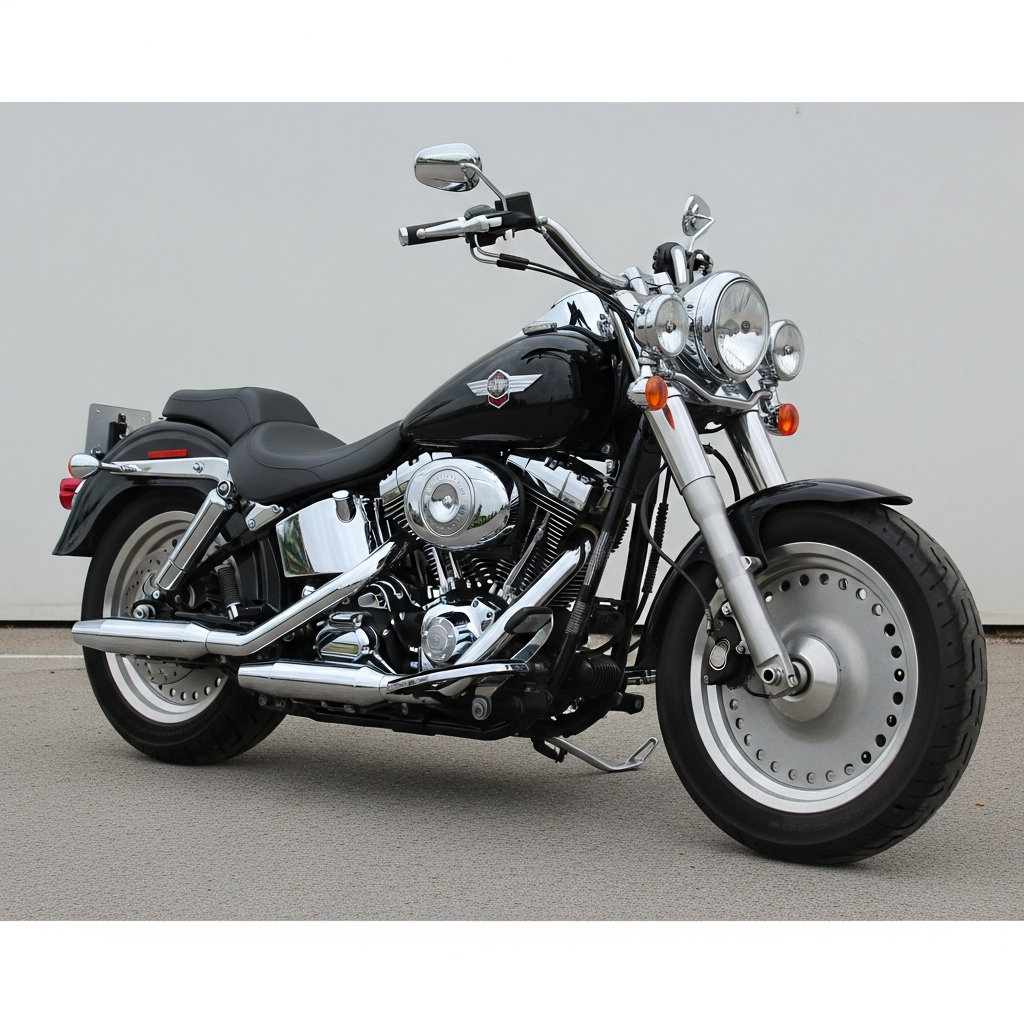
The 2000 – 2006 Harley Davidson Fat Boy represents a pivotal chapter for one of the most recognizable motorcycles in the American manufacturer’s history. As part of the Softail family, this generation of the Fat Boy, designated as the FLSTF, successfully bridged the gap between classic post-war aesthetics and the demand for more modern performance and reliability at the turn of the new millennium. It carried forward the iconic “steamroller” stance that made the original a legend while introducing significant mechanical upgrades that defined its character for years to come.
A New Heart: The Twin Cam 88B Engine
The most substantial difference between the 2000-2006 Fat Boy and its predecessors was the introduction of the Twin Cam 88B engine. This new powerplant replaced the venerable Evolution engine that had powered Harley-Davidson’s Big Twin lineup since the mid-1980s. The “88” signified its displacement of 88 cubic inches (1450cc), a notable increase from the 80 cubic inches (1340cc) of the Evolution engine, providing a welcome boost in both horsepower and torque.
Crucially, the “B” in 88B stood for “balanced.” Unlike the rubber-mounted engines used in the Dyna and Touring lines, the Softail frame featured a rigidly mounted engine. To mitigate the increased vibration of the new Twin Cam design, Harley-Davidson engineered it with internal counter-balancers, resulting in a smoother ride at idle and across the rev range without sacrificing the essential character feel of a V-Twin.
Initially, this new engine was fed by a 40mm constant-velocity (CV) carburetor. However, as the generation progressed, Harley-Davidson increasingly offered its Delphi Electronic Sequential Port Fuel Injection (EFI) system as an option, which became standard in later years. This offered improved cold starts, better fuel economy, and more consistent performance in varying altitudes and temperatures.
Iconic Design and Styling of the 2000 – 2006 Harley Davidson Fat Boy
While the engine was new, the styling remained quintessentially Fat Boy. The motorcycle retained its powerful, low-slung, and muscular presence, which had been its hallmark since its debut. The design philosophy was one of substantial, unapologetic American iron, drawing inspiration from the “hardtail” choppers of the 1960s and 70s, but with the hidden comfort of the Softail’s rear suspension.
Key Styling Elements
The defining features of the Fat Boy during this period were largely unchanged from the original, solidifying its visual identity:
Solid Disc Wheels: The most recognizable feature remained the solid, cast-aluminum disc wheels, front and rear. These 16-inch wheels gave the bike its signature, monolithic appearance.
Massive Front End: A wide, beefy front fork, covered in chrome, held a fat front tire, contributing to the bike’s “fat” moniker and commanding road presence.
Shotgun Exhaust: The classic over-under dual “shotgun” exhaust pipes ran along the right side of the bike, providing the deep, resonant soundtrack expected from a Harley-Davidson Big Twin.
Floorboards and Wide Handlebars: Rider comfort for cruising was prioritized with full-sized floorboards instead of pegs and wide, pullback handlebars that created a relaxed, commanding riding position.
“Hardtail” Look:** The genius of the Softail frame was its hidden rear suspension. Two horizontally mounted shock absorbers were tucked underneath the transmission, giving the clean, unbroken lines of a vintage rigid frame while providing a comfortable ride.
The Fat Boy’s blend of modern engineering with timeless, nostalgic styling made it immensely popular. It was a machine that performed reliably on long cruises but also served as a stunning piece of mechanical art, appealing to a broad range of riders who wanted a classic look without the mechanical fuss of a vintage motorcycle.
Specifications Table: 2000 – 2006 Harley-Davidson Fat Boy (FLSTF)
| General | |
| Brand | Harley-Davidson |
| Model | Fat Boy |
| Model Class | Softail |
| Model Year | 2000 – 2006 |
| Type | Cruiser |
| Maximum mass (GVWR) | 1085 lb. (492 kg) |
| Maximum passengers | 2 |
| Performance | |
| Max. power (approx.) | 63 Hp (47 kW) / 5200 RPM |
| Max. torque (approx.) | 85 ft-lb (115 N•m) / 3500 RPM |
| Top designed speed | ~105 mph (~169 km/h) |
| Size | |
| Length | 94.3 in. (2395 mm) |
| Width | 39.0 in. (991 mm) |
| Height | 44.7 in. (1135 mm) |
| Wheelbase | 64.5 in. (1638 mm) |
| Seat height (laden) | 25.2 in. (640 mm) |
| Ground clearance | 5.1 in. (130 mm) |
| Curb weight | 705 lb. (320 kg) |
| Engine | |
| Type | Air-cooled, Twin Cam 88B™, 45° V-Twin |
| Displacement | 88 cu in (1450 cc) |
| Bore × Stroke | 3.75 in. × 4.00 in. (95.3 mm × 101.6 mm) |
| Compression ratio | 8.9: 1 |
| Starting system | Electric starter |
| Fuel supplying system | 40mm CV Carburetor or optional Electronic Sequential Port Fuel Injection (ESPFI) |
| Ignition control system | Electronic |
| Lubricating system | Dry-sump |
| Oil capacity | 3.5 qt (3.3 L) |
| Engine oil type | SAE 20W-50 Harley-Davidson H-D 360 Motorcycle Oil |
| Idle speed | 950 – 1050 RPM |
| Transmission | |
| Transmission type | 5-speed, manual gear shift |
| Clutch type | Wet, multi-disc, manual |
| Driving system | Belt drive |
| Primary drive | Chain, 36/25 ratio |
| Final drive ratio | 32/70 |
| Gear ratio | 1st: 10.110; 2nd: 6.958; 3rd: 4.953; 4th: 3.862; 5th: 3.150 |
| Chassis | |
| Tire size | Front: MT90B16; Rear: 150/80B16 |
| Rim size | Front: 16 in. Cast Aluminum Disc; Rear: 16 in. Cast Aluminum Disc |
| Capacity of fuel tank | 5.0 gal (18.9 L) |
| Fuel consumption (approx.) | ~42 MPG (5.6 L / 100 km) combined |
| Electric | |
| Battery | 12V Sealed, 19Ah |
| Headlight | Halogen Sealed Beam |
| Tail light | Incandescent Bulb |
| Suspension | |
| Front Suspension | 41.3 mm telescopic fork |
| Front travel | 5.1 in (130 mm) |
| Rear Suspension | Hidden horizontal-mounted coil-over shocks |
| Rear travel | 4.3 in (109 mm) |