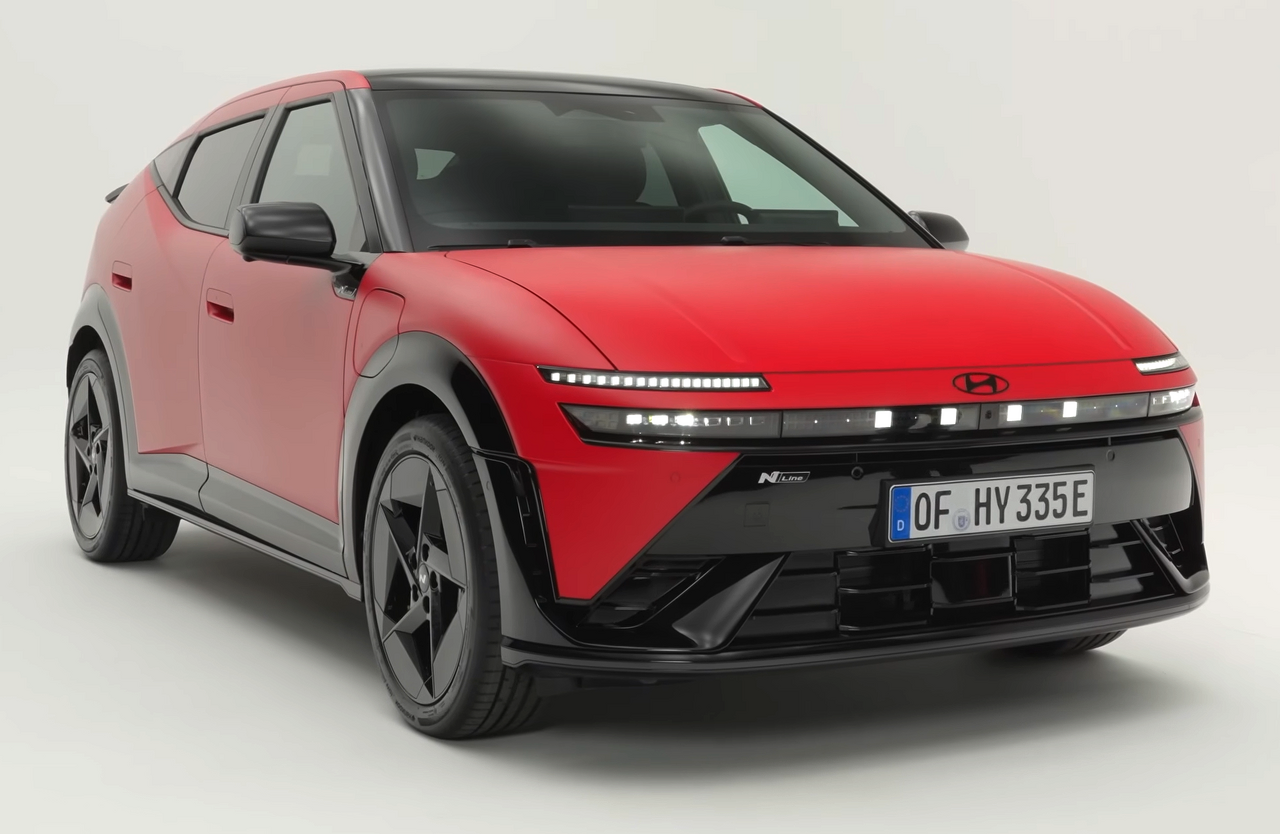
Hyundai Ioniq 3 Specs, Range, Battery, Dimensions & Features
Eletric Car Hyundai Ioniq 3 Specs, Performance, Range, Dimensions & Features
| Hyundai Ioniq 3 | |
|---|---|
_front_view_02.png)
Hyundai Ioniq 3 N Line
|
|
| Overview | |
| Manufacturer | Hyundai |
| Model code | BJ1 |
| Production | August 2026 – present |
| Model years | 2027 – present |
| Assembly | Turkey: İzmit (HAOS) |
| Designer | SangYup Lee |
| Body and chassis | |
| Class | Subcompact car (B) |
| Body style | 5-door hatchback |
| Layout | Front-motor, front-wheel-drive |
| Platform | Hyundai E-GMP (400V architecture) |
| Related | Kia EV2 |
| Powertrain | |
| Electric motor | Permanent magnet on Front Axle |
| Power output | 99–107 kW (133–143 hp; 135–145 PS) |
| Battery | 42.2 or 61 kWh in size, material unknown |
| Range | 344–496 km (214–308 mi) (WLTP) |
| Dimensions | |
| Wheelbase | 2,680 mm (106 in) |
| Length | 4,155–4,170 mm (164–164 in) |
| Width | 1,800 mm (71 in) |
| Height | 1,505 mm (59 in) |
| Kerb weight | 1,550–1,580 kg (3,417–3,483 lb) |
The Hyundai Ioniq 3 is a battery electric subcompact car / supermini car produced by Hyundai since 2026.
It is the fourth product marketed under the electric car-focused Ioniq sub-brand, after the Ioniq 9.
History
The Ioniq 3 is an electric subcompact car, also known in European classification as a “supermini car”. As confirmed by Hyundai’s European CEO Xavier Martinet, the Ioniq 3 will be built in Turkey from August 2026. Martinet confirmed that the model will launch sometime in the third quarter of 2026.
The starting price is expected to be around €30,000, and the Ioniq 3 uses the Art of Steel design language, which was first introduced from the second generation Hyundai Nexo.
The Ioniq 3 was previewed by the Concept THREE, which was revealed on 8 September 2025, in Munich, Germany.
The Ioniq 3 was first teased on 14 April 2026. It was unveiled in Milan, Italy, during Milan Design Week on 20 April 2026, and stays true to the concept model.
Three months later, it was debuted in the Netherlands on 31 July 2026.
Design
The Ioniq 3 is Hyundai’s first dedicated electric vehicle designed in Europe.
It has some inspiration from the Veloster, which was formerly Hyundai’s sports compact car produced from 2012 to 2022, along with the Art of Steel design language, and it features the split headlights with illuminated dots above the grille.
The N-Line variant has a diffuser integrated into the rear bumper and a custom rear spoiler. The A-pillar, roof, side skirts, and cladding are all painted black.
-
_rear_view.png) Rear view (N Line)
Rear view (N Line) -
_interior.png) Interior (N Line)
Interior (N Line)
Features
The Ioniq 3 has a centre touchscreen with a size of 14.6 inches. Hyundai chose to keep physical buttons for the Ioniq 3. Lower trim levels use a 12.9-inch central touchscreen. Hyundai’s Android-based Pleos software-defined infotainment system is used like in the Kia PV5. It has an electronic column shifter mounted on the right stalk. Hyundai also designed the center console to be two-story.
Powertrain
The Standard Range version has an electric motor producing 107 kW (143 hp; 145 PS) paired to a 42.2 kWh battery. It gets a range of 344 kilometres (214 mi) on the WLTP cycle. The long-range model is less powerful, using a 99 kW (133 hp; 135 PS) motor compared to the 107 kW of the Standard Range. It uses a 61 kWh battery that allows the Long Range version to get a range of 496 kilometres (308 mi) on the same cycle. Both versions have a torque output of 249 N⋅m (25.4 kg⋅m; 184 lb⋅ft) regardless of power output.
It is Hyundai’s first dedicated electric vehicle to feature the 400-volt architecture.
Production
The Ioniq 3 is produced at the Hyundai Assan Otomotiv plant in İzmit, Turkey, where it is built alongside the i10, i20, and Bayon, as the Hyundai’s first dedicated electric vehicle to be assembled in Europe.
Production commenced in August 2026.
Hyundai Concept Three
The Ioniq 3 was previewed at the 2025 Munich Motor Show in Germany as a near-ready concept called the Concept Three (stylized as Concept THREE). The Concept THREE features the Art of Steel design language, equipped with a rear ducktail spoiler and diffuser, a raked visor-shaped glasshouse, and narrow wrap-around lights.
-
.jpg) Hyundai Three concept
Hyundai Three concept -
.jpg) Rear view
Rear view -
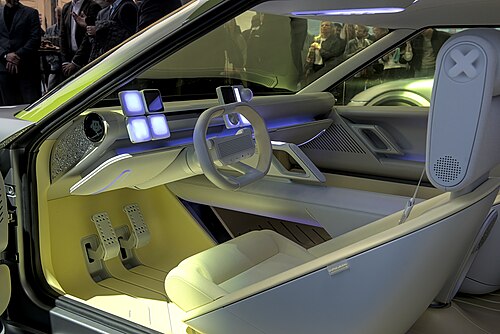 Interior
- Official website (Hyundai UK)