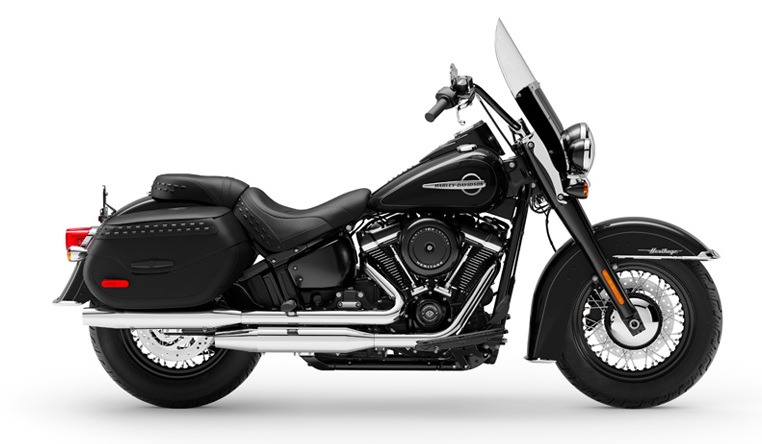
2007–2011 Harley-Davidson Touring Twin Cam 96 (FLHR Road King)
The 2007–2011 Harley-Davidson Touring Twin Cam 96 (FLHR Road King) represents a significant era for the company’s long-haul motorcycle lineup, marking a substantial evolution from its predecessors. This period saw the introduction of a larger, more powerful engine and a host of refinements aimed at improving performance, comfort, and long-distance capability. The FLHR Road King, with its classic styling and versatile nature, served as a flagship model embodying these advancements, appealing to riders seeking both nostalgic aesthetics and modern engineering.
This generation of Touring models was defined by the transition from the Twin Cam 88 engine to the new Twin Cam 96. This was not merely an incremental update; the new powerplant offered a noticeable increase in performance. Displacement grew from 88 cubic inches (1450 cc) to 96 cubic inches (1584 cc), achieved by increasing the stroke length. This resulted in a significant boost in torque, providing stronger acceleration and better passing power, especially when riding with a passenger or fully loaded with gear.
Complementing the new engine was the introduction of the 6-speed Cruise Drive transmission, which replaced the previous 5-speed gearbox. The additional gear functioned as a true overdrive, lowering engine RPM at highway speeds. This change led to a smoother, quieter ride, reduced vibration, and improved fuel economy during long stretches of travel. Furthermore, Electronic Sequential Port Fuel Injection (ESPFI) became standard across the Touring line, improving throttle response, reliability, and cold-start performance compared to the carbureted options of the past.
The Twin Cam 96 FLHR Road King
During this period, the FLHR Road King continued to be a cornerstone of the Harley-Davidson Touring family. It was celebrated for its pure, classic styling that paid homage to the big cruisers of the 1950s. Key visual features included the large, detachable windshield, a prominent chrome headlamp nacelle, and leather-wrapped hard saddlebags. This design gave the Road King a unique versatility; with the windshield and saddlebags attached, it was a capable long-distance tourer, but they could be quickly removed to create a stripped-down cruiser for around-town riding.
The rider experience was a focal point. The Road King featured a comfortable, upright riding position with full-length footboards, a wide handlebar, and a plush touring saddle. These ergonomic features made it well-suited for covering hundreds of miles in a single day without excessive rider fatigue.
Chassis and Technical Enhancements
While the 2007 and 2008 models introduced the new powertrain, a landmark update for the entire Touring platform arrived in 2009. Harley-Davidson unveiled a completely redesigned frame and swingarm. The new single-spar, rigid backbone frame was engineered to increase load-carrying capacity and dramatically improve handling dynamics.
This new chassis, paired with a wider rear wheel and updated engine mounting system, addressed criticisms of high-speed instability that could affect earlier models, providing a more planted and confident feel on the highway and in corners. Anti-lock Braking System (ABS) also became a widely available option during this era, adding a significant layer of safety. The combination of the more powerful Twin Cam 96 engine, the 6-speed transmission, and the much-improved 2009-onward frame made these Road King models highly sought after for their balance of classic style and modern road manners.
*
Specifications: 2009 Harley-Davidson FLHR Road King**
| General | |
| Brand | Harley-Davidson |
| Model | Road King |
| Model Class | FLHR |
| Model Year | 2007–2011 (Specs for 2009) |
| Type | Touring / Cruiser |
| Gross Vehicle Weight Rating | 1360 lb. (617 kg) |
| Maximum passengers | 2 |
| Performance | |
| Max. power | Not officially published by manufacturer |
| Max. torque | 92.6 ft-lb (125.6 N•m) / 3500 RPM |
| Size | |
| Length | 94.2 in. (2393 mm) |
| Width | 37.5 in. (953 mm) |
| Height | 57.9 in. (1471 mm) |
| Wheelbase | 63.5 in. (1613 mm) |
| Seat height (laden) | 27.3 in. (693 mm) |
| Ground clearance | 5.1 in. (130 mm) |
| Curb weight (running order) | 774 lb. (351 kg) |
| Engine | |
| Type | Air-cooled, 45° V-Twin, Four Stroke |
| Displacement | 96 cu in (1584 cc) |
| Bore × Stroke | 3.75 in. × 4.38 in. (95.3 mm × 111.1 mm) |
| Compression ratio | 9.2:1 |
| Starting system | Electric starter |
| Fuel supplying system | Electronic Sequential Port Fuel Injection (ESPFI) |
| Lubricating system | Pressurized, dry-sump |
| Oil capacity | 4.0 qt (3.8 L) |
| Engine oil type | Harley-Davidson H-D 360 SAE 20W50 |
| Transmission | |
| Transmission type | 6-speed Cruise Drive, manual gear shift |
| Clutch type | Wet, multi-disc, manual |
| Driving system | Belt drive |
| Primary reduction ratio | 1.353 (34/46) |
| Final reduction ratio | 2.125 (32/68) |
| Gear ratio | 1st: 9.311; 2nd: 6.454; 3rd: 4.793; 4th: 3.882; 5th: 3.307; 6th: 2.790 |
| Chassis | |
| Tire size | Front: 130/80B17; Rear: 180/65B16 |
| Rim size | Front: 17 in.; Rear: 16 in. |
| Capacity of fuel tank | 6.0 gal (22.7 L) |
| Fuel consumption (combined) | Approx. 35 mpg (city) / 54 mpg (highway) |
| Electric | |
| Battery | 12V / 28 Ah |
| Headlight | Halogen Sealed Beam |
| Tail light | Incandescent |
| Suspension | |
| Front suspension | 41.3 mm telescopic fork |
| Front travel | 4.6 in (117 mm) |
| Rear suspension | Air-adjustable shock absorbers |
| Rear travel | 3.0 in (76 mm) |
| Rear spring preload | Adjustable via air pressure |