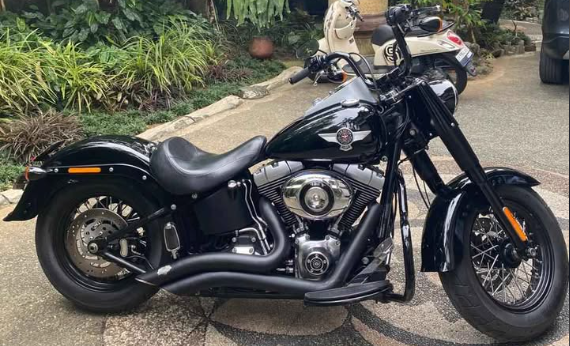
2000–2006 Harley-Davidson Softail Twin Cam 88B (FXST Standard)
The 2000–2006 Harley-Davidson Softail Twin Cam 88B (FXST Standard) represents a significant era for the American motorcycle manufacturer, bridging the classic appeal of its heritage with a new generation of engineering. Serving as the entry-level model in Harley-Davidson’s “Big Twin” Softail family, the FXST Softail Standard became a popular platform for both new riders and seasoned customizers. It successfully replaced the venerable Evolution-powered Softail Standard by introducing a more powerful and refined engine while retaining the minimalist, chopper-inspired styling that defined the model.
The introduction of the Twin Cam engine in 1999 for Dyna and Touring models marked a major engineering leap for Harley-Davidson. For the year 2000, this technology was adapted for the Softail lineup. The key distinction was the development of the “B” variant of the engine—the Twin Cam 88B. Unlike the rubber-mounted Twin Cam 88A engines used in other families, the Softail frame required the engine to be rigid-mounted. To counteract the intense vibration this would create, Harley-Davidson engineered the 88B with internal, chain-driven counter-balancers, resulting in a smoother ride at idle and across the rev range without sacrificing the signature V-twin feel.
The Twin Cam 88B Engine and Performance
At the heart of the 2000–2006 Harley-Davidson Softail Twin Cam 88B (FXST Standard) is its namesake air-cooled, 1450cc (88 cubic inch) 45-degree V-twin engine. As its “Twin Cam” name implies, the engine utilized two camshafts in the crankcase to actuate the valvetrain, a departure from the single cam design of the preceding Evolution engine. This setup allowed for improved airflow, higher engine speeds, and increased overall performance.
Mated to the engine was a five-speed transmission that delivered power to the rear wheel via a clean and low-maintenance belt drive system. Early models in this generation (2000-2001) primarily used a 40mm constant velocity (CV) carburetor for fuel delivery, providing a classic, analog feel. From 2001 onward, Harley-Davidson began offering Sequential Port Fuel Injection (EFI) as an option, which became standard on all Softails by the end of this model run. The EFI system offered improved cold starts, better fuel economy, and crisper throttle response.
Chassis, Design, and Evolution
The FXST Softail Standard is built upon the iconic Softail frame, which cleverly hides the rear shock absorbers horizontally beneath the transmission. This design provides the clean, rigid-axle appearance of a vintage “hardtail” motorcycle while offering the comfort of a modern suspension system.
The “Standard” model was intentionally designed as a stripped-down, blank canvas. Its styling cues included:
A raked-out front end with a 21-inch laced front wheel.
Forward-mounted foot controls for a classic cruiser riding posture.
A “bobtail” rear fender and a solo seat.
Minimalist chrome and badging compared to other models like the Fat Boy or Heritage Softail.
This bare-bones approach made it one of the most affordable Big Twins in the lineup and a favorite starting point for customization, allowing owners to easily modify everything from the handlebars and exhaust to the paint and accessories.
Differences from the Evolution-powered Model
The transition to the Twin Cam 88B platform brought several key upgrades over the pre-2000 FXST Softail Standard, which used the 1340cc Evolution engine.
Engine: The most significant change was the move from the 82 cubic inch (1340cc) Evolution engine to the 88 cubic inch (1450cc) Twin Cam 88B. This resulted in a noticeable increase in both horsepower and torque, providing better acceleration and highway performance.
Frame and Mounting: The Softail frame was re-engineered to accommodate the larger dimensions and mounting points of the Twin Cam engine.
Braking System: The braking system was improved, moving to four-piston calipers front and rear, which offered superior stopping power compared to the single-piston calipers on many earlier models.
Fuel System: The introduction of optional and later standard EFI provided a modern alternative to the traditional carburetor.
The 2000-2006 FXST Softail Standard was eventually succeeded in 2007 by a new generation of Softails featuring the larger Twin Cam 96B engine and a six-speed transmission, but its legacy as a reliable, stylish, and highly customizable machine endures.
Specifications Table: 2006 Harley-Davidson FXST Softail Standard
| General | |
| Brand | Harley-Davidson |
| Model | Softail Standard |
| Model Class | FXST |
| Model Year | 2000–2006 |
| Type | Cruiser |
| Gross Vehicle Weight Rating | 1085 lb. (492 kg) |
| Maximum passengers | 2 (with optional passenger seat and pegs) |
| Performance | |
| Max. power (est.) | ~63 Hp / 5300 RPM |
| Max. torque | 85 ft-lb (115 N•m) / 3000 RPM |
| Top designed speed (est.) | 105 mph (169 km/h) |
| Size | |
| Length | 94.3 in. (2395 mm) |
| Width | 36.2 in. (920 mm) |
| Wheelbase | 66.6 in. (1692 mm) |
| Seat height (laden) | 26.1 in. (663 mm) |
| Ground clearance | 5.6 in. (141 mm) |
| Curb weight | 677 lb. (307 kg) |
| Engine | |
| Type | Air-cooled, Twin Cam 88B (counter-balanced), 45° V-Twin |
| Displacement | 88 ci (1450 cc) |
| Bore × Stroke | 3.75 in. × 4.00 in. (95.3 mm × 101.6 mm) |
| Compression ratio | 8.9: 1 |
| Starting system | Electric starter |
| Fuel supplying system | 40mm CV Carburetor or Electronic Sequential Port Fuel Injection (ESPFI) |
| Lubricating system | Dry-sump |
| Oil capacity | 3.5 qt (3.3 L) |
| Transmission | |
| Transmission type | 5-speed, manual |
| Clutch type | Wet, multi-disc, manual |
| Driving system | Belt drive |
| Primary reduction ratio | 1.353 |
| Final reduction ratio | 2.188 |
| Chassis | |
| Tire size | Front: MH90-21; Rear: 150/80B16 |
| Rim type | Front: Laced Steel; Rear: Slotted Disc Cast Aluminum |
| Capacity of fuel tank | 5.0 gal (18.9 L) |
| Fuel consumption (est.) | Combined: ~44 mpg (5.3 L / 100 km) |
| Electric | |
| Battery | 12V / 19 Ah |
| Headlight | 55W/60W Halogen |
| Suspension | |
| Front suspension | 41.3 mm telescopic fork |
| Front travel | 5.1 in (130 mm) |
| Rear suspension | Hidden, horizontal-mounted coil-over shocks |
| Rear travel | 4.3 in (109 mm) |