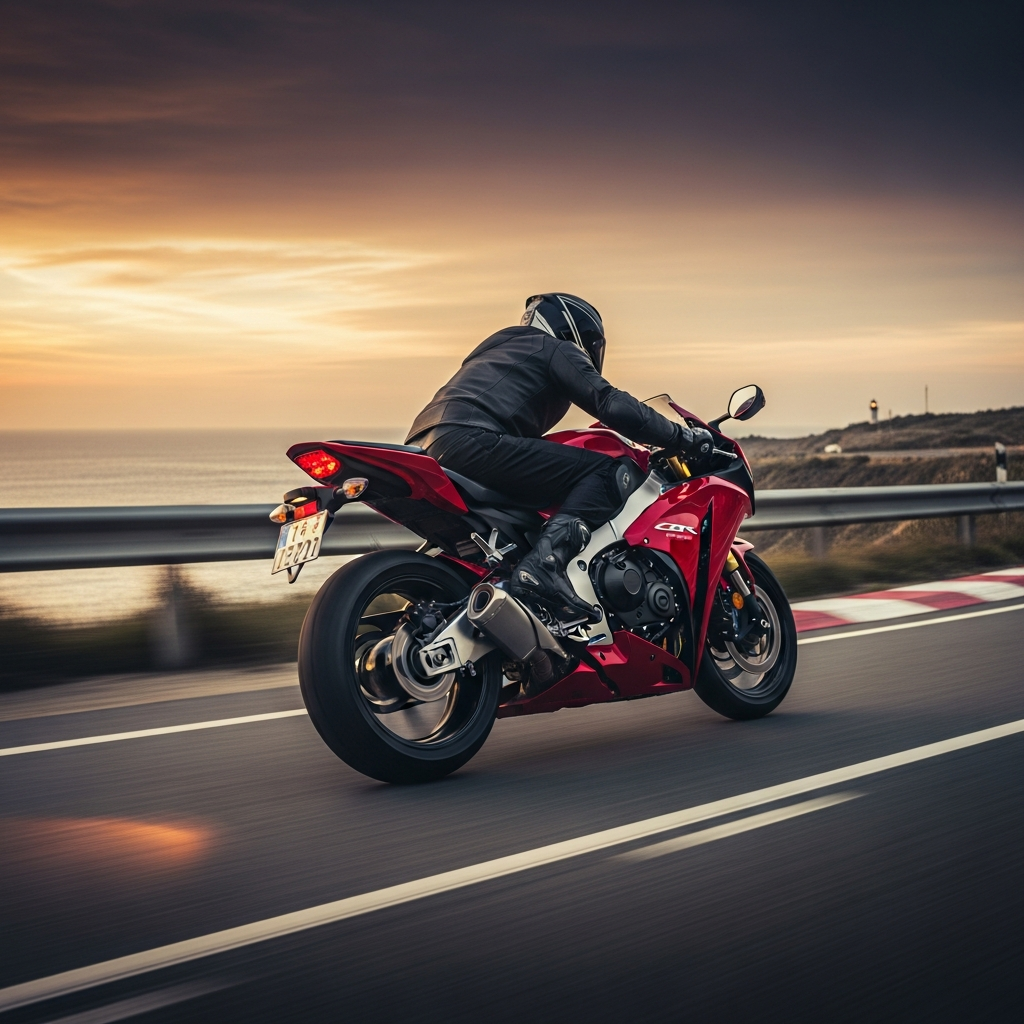
The Honda CBR1000RR 2012, also known as the Fireblade, represents a significant evolution in the lineage of Honda’s flagship superbike, launched to commemorate the 20th anniversary of the original 1992 CBR900RR. Rather than a ground-up redesign, the 2012 model was a comprehensive refinement of the existing 2008-2011 platform, focusing on enhancing the machine’s core philosophy of “Total Control.” The updates centered on improving chassis feedback, suspension performance, and overall rider connection, reinforcing its reputation as a supremely balanced and user-friendly liter-class sportbike.
Development and Design Philosophy
Honda’s approach for the 2012 CBR1000RR was to perfect a proven formula. The engineering team concentrated on areas that would provide the most tangible benefits to the rider on both the road and the racetrack. The primary goals were to create a motorcycle with more intuitive handling, better suspension compliance, and clearer feedback from the tires. This was achieved not by adding more peak horsepower, but by refining the components that connect the rider to the road.
Visually, the motorcycle received a more aggressive and aerodynamic design. The fairings were restyled with a layered concept to improve heat management and high-speed stability. The nose of the bike was sharpened, and the side fairings incorporated more angular lines, giving the bike a more contemporary and purposeful look compared to its predecessor’s more rounded aesthetic.
Technical Updates to the Honda CBR1000RR 2012
The most substantial upgrades for the 2012 model year were found in the chassis and suspension components, directly addressing the goal of enhanced handling and feel.
Suspension and Chassis
The single most important update was the adoption of state-of-the-art Showa suspension components. The front end was equipped with a 43mm Showa Big Piston Fork (BPF). Unlike a conventional cartridge fork, the BPF design uses a much larger main piston, which reduces internal hydraulic pressure and results in smoother, more responsive action, especially during initial fork compression. This provided the rider with superior front-end feel and increased stability under hard braking.
At the rear, the 2012 CBR1000RR debuted Honda’s first use of the Balance-Free Rear Cushion. This advanced Showa shock absorber features a unique double-tube design that separates the damping fluid from compressed nitrogen gas. This design eliminates the pressure fluctuations common in conventional shocks, providing more consistent and predictable damping performance over a wide range of conditions. The result was improved rear-wheel traction and a more connected feel for the rider.
Complementing the new suspension were new 12-spoke cast aluminum wheels. These wheels were designed to offer more consistent rigidity, working in harmony with the new forks and shock to provide clearer feedback to the rider.
Engine and Electronics
The 999cc liquid-cooled inline-four engine remained mechanically similar to the previous generation, known for its potent midrange torque and linear power delivery. However, Honda engineers revised the settings for the Programmed Dual Stage Fuel Injection (PGM-DSFI) system. These new fuel maps were designed to create a smoother, more linear throttle response, particularly at smaller throttle openings, making the bike easier to manage when transitioning from off-throttle to on-throttle.
A notable characteristic of the 2012 CBR1000RR was its deliberate lack of a traction control system, a feature that was becoming standard among its key competitors. Honda’s philosophy was that a well-balanced chassis, refined power delivery, and superior mechanical grip offered a purer and more engaging riding experience. The bike was also available with Honda’s electronically controlled Combined ABS (C-ABS), a sophisticated “brake-by-wire” system that offered powerful, linked braking without wheel lock-up.
Instrumentation
The rider interface was completely modernized with a new, fully digital multi-function LCD instrument panel. This replaced the analog tachometer of the previous model and offered a wealth of information, including a gear position indicator, a four-mode lap timer, a programmable shift light, and customizable readouts for speed and engine RPM.
Comparison with the Predecessor (2008-2011)
While sharing the same fundamental frame and engine architecture, the 2012 CBR1000RR was a distinct step forward from the 2008-2011 model. The key differences were:
Suspension: The move from a conventional 43mm HMAS cartridge fork and standard monoshock to the Showa Big Piston Fork and Balance-Free Rear Cushion was the most significant performance upgrade.
Wheels: The previous three-spoke wheels were replaced by stiffer and more modern 12-spoke wheels.
Styling: The bodywork was redesigned for a sharper, more angular appearance compared to the softer lines of the earlier model.
Instrumentation: A fully digital LCD dash replaced the previous generation’s analog tachometer and LCD screen combination.
Engine Feel: Revised fuel mapping provided a slightly smoother and more precise throttle response.
Specifications
| Specification | Value |
| :— | :— |
| Brand | Honda |
| Model | CBR1000RR |
| Model Class | Fireblade |
| Model Year | 2012 |
| Type | Superbike / Sportbike |
| General | |
| Maximum mass | 831.1 lbs (377 kg) |
| Maximum passengers | 2 |
| Performance | |
| Max. power | 175.6 Hp (131 kW) / 12,000 RPM |
| Max. torque | 82.7 ft-lb (112 N•m) / 8,500 RPM |
| Min. turn diameter | 21.3 ft (6.5 m) |
| Top designed speed | 178 mph (286 km/h) |
| Size | |
| Length | 81.5 in. (2070 mm) |
| Width | 32.5 in. (825.5 mm) |
| Height | 44.7 in. (1135 mm) |
| Wheelbase | 55.5 in. (1410 mm) |
| Seat height | 32.3 in. (820 mm) |
| Ground clearance | 5.1 in. (130 mm) |
| Curb weight | 440.9 lbs (200 kg) / 465.2 lbs (211 kg) with C-ABS |
| Engine | |
| Type | Inline-Four, 16-valve, Four Stroke, Liquid Cooled, DOHC |
| Displacement | 999 cc |
| Bore × Stroke | 3.0 in. × 2.17 in. (76 mm × 55.1 mm) |
| Compression ratio | 12.3: 1 |
| Starting system | Electric starter |
| Fuel supplying system | Programmed Dual Stage Fuel Injection (PGM-DSFI) |
| Ignition control system | Computer-controlled digital transistorized with 3-D mapping |
| Lubricating system | Wet Sump |
| Oil capacity | When changing an oil filter: 3.3 qt (3.1 L) |
| Engine oil type | SAE 10W-30 or 10W-40, API service classification SG or higher |
| Coolant capacity | 3.2 qt (3.0 L) |
| Coolant type | Pro Honda HP Coolant or equivalent silicate-free ethylene glycol |
| Idle speed | 1200 RPM ± 100 RPM |
| Transmission | |
| Transmission type | 6-speed, close-ratio, manual gear shift |
| Clutch type | Wet, multi-disc, manual |
| Driving system | #530 O-ring-sealed chain drive |
| Primary reduction ratio | 1.717 |
| Final reduction ratio | 2.625 |
| Gear ratio | 1st: 2.286; 2nd: 1.778; 3rd: 1.500; 4th: 1.333; 5th: 1.214; 6th: 1.138 |
| Chassis | |
| Tire size | Front: 120/70 ZR17; Rear: 190/50 ZR17 |
| Rim size | Front: 17 x MT3.5; Rear: 17 x MT6.0 |
| Capacity of fuel tank | 4.6 gal (17.5 L) |
| Fuel consumption | Approx. 37 MPG (6.3 L / 100 km) |
| Electric | |
| Battery | 12V / 10 Ah (YTZ10S) |
| Headlight | 12V, 55W (H7) x 2 |
| Position Light | N/A |
| Turning light | 12V, 21W x 4 |
| Tail light | LED |
| Front fog light | N/A |
| Shock Absorbers | |
| Front travel | 4.3 in (110 mm) |
| Front rebound damping | Fully Adjustable |
| Front compression damping | Fully Adjustable |
| Rear travel | 5.4 in (138 mm) |
| Rear rebound damping | Fully Adjustable |
| Rear compression damping | Fully Adjustable |
| Rear spring preload** | Fully Adjustable |