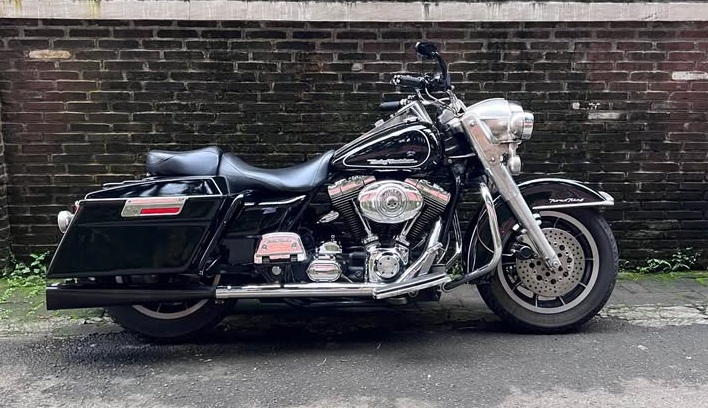
The 1995–1998 Harley-Davidson Touring Evolution 1340 (FLHT Electra Glide Standard) represents a significant and beloved era for the American motorcycle manufacturer. Positioned as the foundational model in the touring lineup, the FLHT offered riders the essential elements of a long-haul machine—the iconic batwing fairing, spacious hard saddlebags, and the proven touring chassis—without the additional electronics and trim of its more expensive siblings like the Electra Glide Classic (FLHTC) and Ultra Classic (FLHTCU). This period is defined by the venerable Evolution engine, a powerplant that is often credited with saving the company and which reached a state of refined reliability by the mid-1990s.
Historical Context and Development
By 1995, Harley-Davidson had firmly re-established itself as a dominant force in the heavyweight motorcycle market. The Evolution V-twin engine, introduced in 1984, had replaced the leak-prone and less reliable Shovelhead, winning back the confidence of riders with its improved oil-tightness, durability, and performance. The 1995–1998 model years for the FLHT Electra Glide Standard can be seen as the zenith of this platform, representing a period of refinement rather than radical change before the introduction of the Twin Cam engine in 1999.
The FLHT Electra Glide Standard was marketed as a “blank canvas” tourer. It appealed to riders who preferred a more elemental riding experience or those who planned extensive customization. It featured the full touring frame, air-adjustable rear suspension, and fork-mounted fairing, providing the stable ride and wind protection necessary for covering vast distances, but it eschewed the radio, intercom system, and extra chrome that defined the higher-end models.
Key Features of the 1995–1998 Harley-Davidson Touring Evolution 1340
The models produced within this four-year window shared a core identity, though with incremental updates. Their defining characteristics made them a popular choice for touring enthusiasts.
The Evolution 1340 “Blockhead” Engine
At the heart of the FLHT was the air-cooled, 45-degree V-twin Evolution engine. Displacing 1340cc (80 cubic inches), the “Evo” was known for its distinctive potato-potato exhaust note, robust torque delivery, and relative simplicity, making it easy for owners to service. Mated to a 5-speed transmission with a clean and quiet belt final drive, the powertrain was optimized for highway cruising, offering relaxed RPMs at speed and ample power for passing.
Advancements and Differences from Previous Models
A key development during this period was the introduction of electronic fuel injection (EFI). Beginning in 1995, Harley-Davidson offered Magneti-Marelli sequential port fuel injection as an option on its touring models, designated by an “I” in the model name (e.g., FLHTI). This was a significant departure from the Keihin carburetor that had been the standard for years. While the carbureted models remained the base offering and were favored by traditionalists for their simplicity, the EFI system provided improved cold-starting, better fuel economy, and automatic adjustment for altitude changes. This technological step forward marked a clear distinction from the exclusively carbureted touring bikes that preceded the 1995 model year. Other refinements included improved braking systems and more robust electrical wiring harnesses compared to earlier Evolution models.
Chassis and Ergonomics
The FLHT was built on Harley-Davidson’s robust touring frame, a design praised for its high-speed stability. The chassis was complemented by a telescopic front fork and dual air-adjustable rear shock absorbers, allowing riders to tune the suspension for passenger and cargo loads. The ergonomics were classic touring: a comfortable, upright riding position with wide handlebars, floorboards for the rider, and a plush one-piece seat. The iconic “batwing” fairing, while lacking a stereo on the Standard model, provided excellent wind and weather protection, reducing rider fatigue on long journeys.
Specifications
| General | |
| Brand | Harley-Davidson |
| Model | FLHT Electra Glide Standard |
| Model Years | 1995–1998 |
| Type | Touring |
| Maximum Passengers | 2 |
| Performance | |
| Max. Power (approx.) | 64 Hp (48 Kw) @ 5000 RPM |
| Max. Torque (approx.) | 78 ft-lb (105 N•m) @ 3000 RPM |
| Top Speed | ~105 mph (~169 km/h) |
| Size | |
| Length | 93.7 in. (2380 mm) |
| Width | 34.2 in. (869 mm) |
| Height | 60.8 in. (1544 mm) |
| Wheelbase | 62.7 in. (1592 mm) |
| Seat Height (Laden) | 27.2 in. (691 mm) |
| Ground Clearance | 5.1 in. (130 mm) |
| Dry Weight | 743 lb. (337 kg) |
| Engine | |
| Type | Evolution Air-Cooled, 45° V-Twin, Four Stroke, OHV |
| Displacement | 1340 cc (80 cu. in.) |
| Bore × Stroke | 3.49 in. × 4.25 in. (88.8 mm × 108 mm) |
| Compression Ratio | 8.5:1 |
| Starting System | Electric starter |
| Fuel System | 40mm Keihin CV Carburetor or Optional Electronic Sequential Port Fuel Injection (ESPFI) |
| Ignition Control System | Electronic |
| Oil Capacity | 4.0 qt (3.8 L) |
| Engine Oil Type | SAE 20W-50 |
| Transmission | |
| Transmission Type | 5-speed, manual |
| Clutch Type | Wet, multi-disc |
| Driving System | Belt drive |
| Primary Reduction Ratio | 1.520 (25/38) |
| Final Reduction Ratio | 2.188 (32/70) |
| Chassis | |
| Tire Size | Front: MT90B16; Rear: MT90B16 |
| Brakes | Front: Dual Disc; Rear: Single Disc |
| Capacity of Fuel Tank | 5.0 gal (18.9 L) |
| Fuel Consumption (approx.) | 42 MPG (5.6 L / 100 km) |
| Electric | |
| Battery | 12V / 28 Ah |
| Headlight | Halogen |
| Suspension | |
| Front Suspension | Telescopic Fork |
| Rear Suspension | Dual air-adjustable shock absorbers |