Aistaland GT7 Specs, Range, Battery, Charging & Features
Eletric Car Aistaland GT7 Specs, Performance, Range, Dimensions & Features
| Aistaland GT7 | |
|---|---|
 |
|
| Overview | |
| Manufacturer | Aistaland |
| Model code | F03 |
| Production | June 2026 – present |
| Assembly | China: Guangzhou (GAC Aion) |
| Body and chassis | |
| Class | Full-size car (E-segment) |
| Body style | 5-door shooting brake |
| Layout |
|
| Related | Aistaland GX7 |
| Powertrain | |
| Engine | 1.5 L Turbo Generator I4 |
| Power output |
|
| Hybrid drivetrain | Range-extended electric (EREV) |
| Battery |
|
| Electric range | 675–900 km (419–559 mi) (CLTC, depending on variant) |
| Dimensions | |
| Wheelbase | 3,000 mm (118.1 in) |
| Length | 5,050 mm (198.8 in) |
| Width | 1,980 mm (78.0 in) |
| Height | 1,470 mm (57.9 in) |
| Curb weight | 2,295 kg (5,060 lb) |
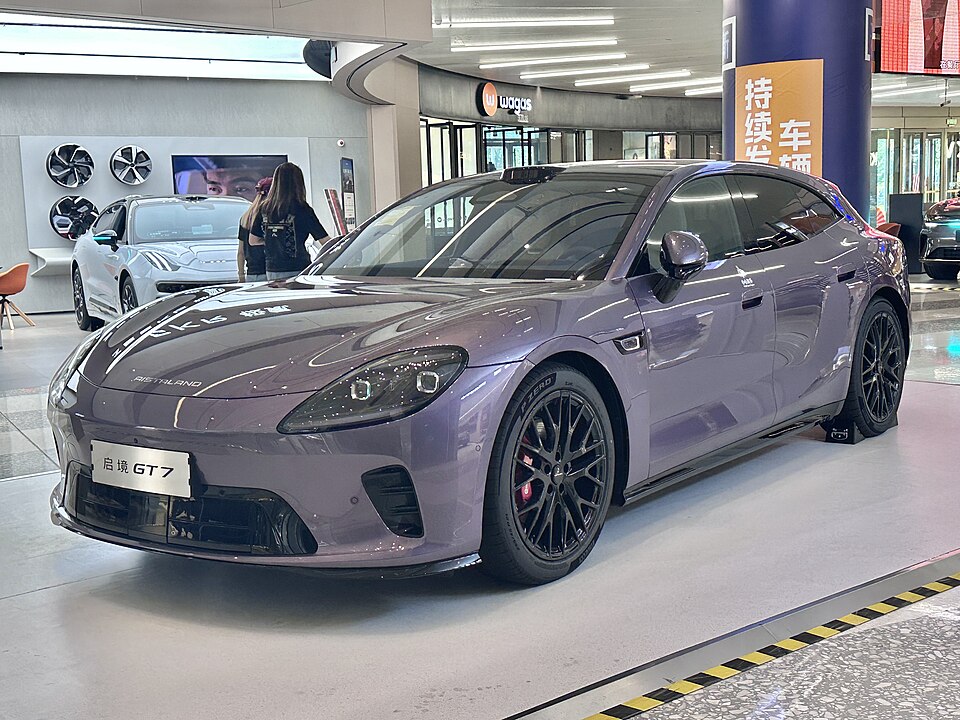
The Aistaland GT7 (Chinese: 启境GT7; pinyin: Qǐjìng GT7) is a battery electric and range-extended full-size shooting brake produced by GAC Group under its Aistaland marque. It is the first model under the Aistaland brand, which is co-developed by GAC Group and Huawei.
History
The Aistaland marque was announced on September 19, 2025, marking GAC’s intensified entry into China’s premium electric vehicle market. Unlike Huawei’s other automotive partnerships, Aistaland is not part of the Harmony Intelligent Mobility Alliance (HIMA). Former GAC executive Liu Jiaming was appointed as chief executive of the new brand on September 25, 2025.
On January 30, 2026, the first images of a camouflaged prototype were released. On March 8, 2026, the vehicle was named the Qijing GT7. The GT7 was officially unveiled on March 17, 2026, alongside the English name of the marque, Aistaland, which is derived from the phrase “AI Start New Land”. Blind orders opened on the same day.
The GT7 was displayed at the 2026 Beijing Auto Show in April 2026. The interior was unveiled in mid-May 2026, and pre-sales opened on May 29, 2026, attracting over 10,000 orders within the first five hours. The GT7 was officially launched on June 26, 2026, with deliveries commencing in July 2026.
Design
The GT7 adopts a low-slung, wide-body shooting brake silhouette with 14 aerodynamic enhancements, including active grille shutters and a clamshell aluminium hood. The front fascia uses a closed grille design with slim, elongated LED headlights and Huawei’s Xpixel smart projection headlights, capable of projecting a 120-inch image. Streamlined semi-concealed door handles are integrated into the body. The rear features a full-width LED light bar.
The interior is available in three colour schemes: Daybreak Red, Starry Night Black, and Moonlight Beige. Display systems include a full LCD instrument cluster, a 15.6-inch central touchscreen, and an augmented reality head-up display with an 88-inch projection area. The steering wheel is a three-spoke unit with dedicated buttons for intelligent driving modes. A 21-speaker Huawei Sound 7.1.4 audio system is fitted.
-
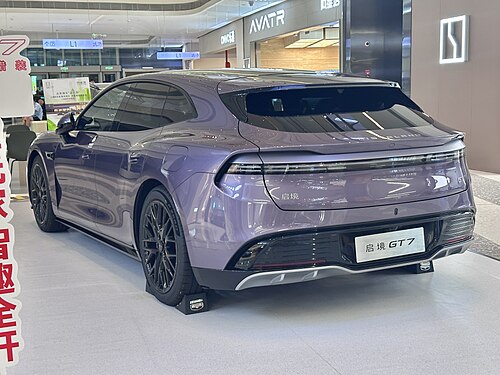 Rear view
 -
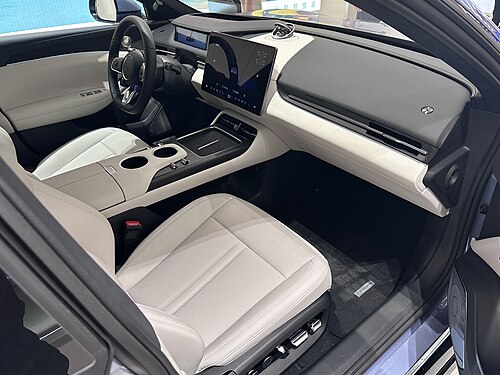 Interior
Powertrain and technology
The GT7 is offered in five trim levels across battery electric and range-extended electric configurations, built on an 800-volt high-voltage architecture. The top specification produces 768 hp (573 kW). The LFP variant uses an 86.111 kWh battery, while the flagship variant uses a 102.768 kWh CATL Qilin nickel manganese cobalt battery.
The GT7 is the first production vehicle to feature Huawei’s Qiankun ADS 5.0 autonomous driving system. The sensor suite on higher trims comprises 36 units, including a next-generation 896-channel dual-path imaging lidar and a distributed 4D millimetre-wave radar. The vehicle obtained permits for L3 autonomous driving road testing in Guangzhou and completed 200,000 km (124,274 mi) of real-world L3-level testing prior to launch. It also features Huawei’s XMC Smart Chassis system and the HarmonySpace 6 cockpit software platform.
| Battery | Capacity | Battery weight | CLTC range |
|---|---|---|---|
| LFP | 86.111 kWh | 600 kg (1,323 lb) | 675–770 km (419–478 mi) |
| Qilin NMC (CATL) | 102.768 kWh | 587 kg (1,294 lb) | 800–900 km (497–559 mi) |
| Kerb weight (all variants) | 2,295 kg (5,060 lb) | ||