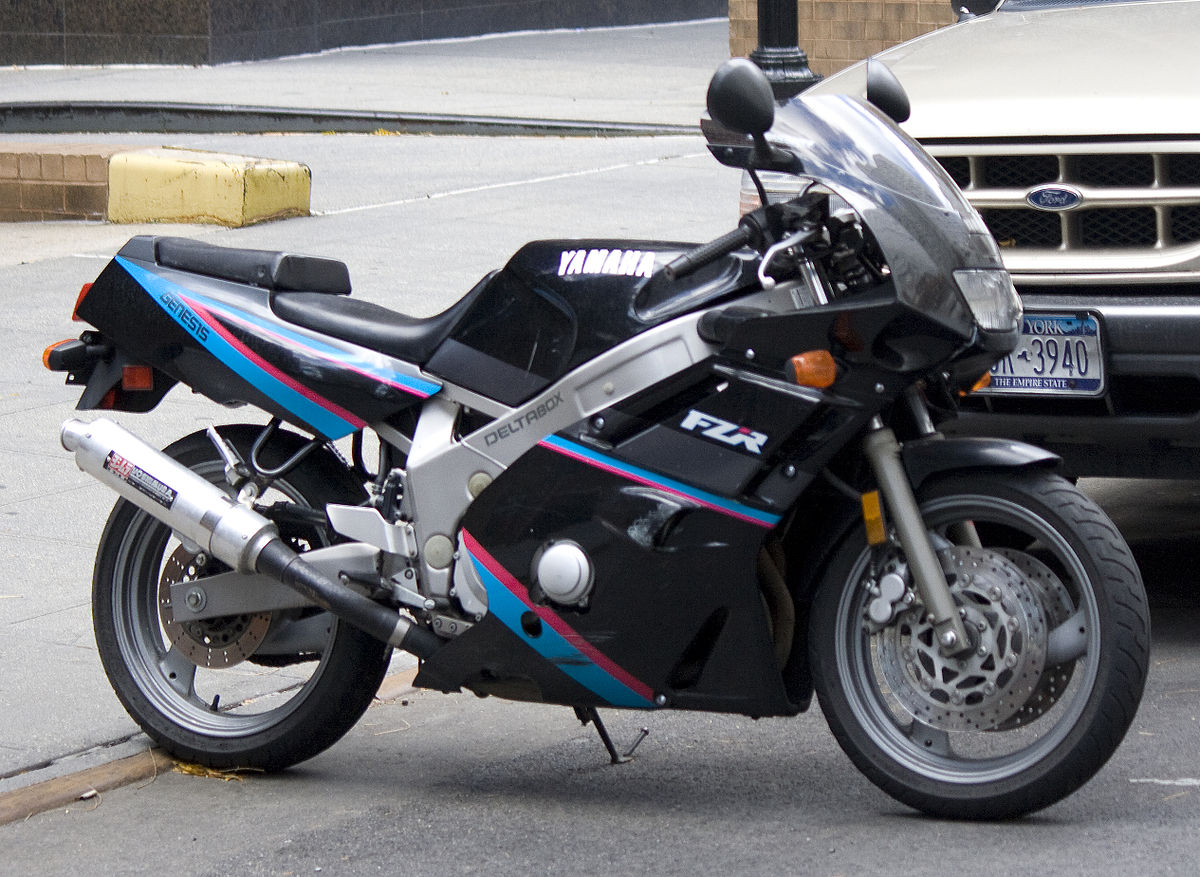
Yamaha FZR600
 |
|
| Manufacturer | Yamaha Motor Company |
|---|---|
| Also called | 3HE, 4JH |
| Production | 1988–1995 |
| Predecessor | Yamaha FZ-600 |
| Successor | YZF-R6 |
| Class | Sport bike |
| Engine | 599 cc, 4-stroke, liquid cooled, inline 4-cylinder, DOHC, 16 valves |
| Bore / stroke | 59.0 mm × 54.8 mm (2.32 in × 2.16 in) |
| Compression ratio | 12,0 : 1 |
| Power | 66.8 kW (89.6 hp) @ 10500 RPM |
| Torque | 65.7 N⋅m (48.5 lbf⋅ft) @ 8500 RPM |
| Ignition type | Digital, transistor controlled |
| Transmission | 6-speed, constant mesh, final drive chain |
| Frame type | steel Deltabox |
| Suspension | Front: telescopic fork travel 130 mm (5.1 in) Rear: swingarm monoshock (link suspension) travel 115 mm (4.5 in) |
| Brakes | Front: double disc 298 mm (11.7 in) Rear: single disc 245 mm (9.6 in) |
| Tires | Front: 110/70VR17 Rear: 140/60VR18 (1991 model-year) |
| Rake, trail | 94 mm (3.7 in) |
| Wheelbase | 1,425 mm (56.1 in) |
| Dimensions | L: 82.5 in (2,100 mm) W: 27.6 in (700 mm) H: 45.5 in (1,160 mm) |
| Seat height | 785 mm (30.9 in) |
| Weight | 181 kg (399 lb) (dry) |
| Fuel capacity | 18 L (4.0 imp gal; 4.8 US gal) |
| Oil capacity | 3.1 L (0.68 imp gal; 0.82 US gal) |
| Related | Yamaha FZR400 Yamaha FZR1000 |
The Yamaha FZR600 is a sports motorcycle produced by Yamaha between 1988 and 1996 (1999 in the USA). It was the successor to the FZ600 and was replaced by the Yamaha YZF600R in 1997. It had a steel Deltabox frame and swingarm, similar in appearance to the alloy Deltabox frame introduced three years earlier on the 1WG FZR400.
The “Deltabox” frame Design
The Yamaha FZR600 engine was slanted forward in the frame. This was the basis of the Genesis engine and Delta Box frame concept, and helped to lower the center of gravity and help centralize mass. This layout allowed the real fuel tank to sit behind the cylinders, low between the frame rails, and further aided with lowering the center of gravity. Forward of this sat the airbox, with four 32 mm Mikuni downdraft carburetors, and all these assemblies were covered by a plastic cover dummy petrol tank.
The 4-Valve design and the “EXUP” exhaust valve
Unlike the larger FZR models, which had featured three intake valves and two exhaust valves per cylinder, the FZR600 had a four valve per cylinder layout, necessitated by the different gas flow characteristics of the 600 cc engine over the 750 and 1,000 cc units in the FZR range. Many models came with the EXUP valve system, mandatory for units sold in California. This system located in the lower exhaust manifold helps maintain high back pressure at low engine speeds, and opens up more at higher engine speeds, giving the motor better mid-range power. The EXUP system was mainly found in US and some European models to compensate for the loss of power caused by emissions related modifications for those markets. Standard world market models produced 99 bhp (74 kW), compared to about 91 bhp (68 kW) for EXUP equipped versions.
Changes over the years
The original steel-framed ‘3HE’ FZR600 remained virtually unchanged throughout its production which began in 1988.
1990
In 1990, the rear wheel width was increased to 4 inches, which is up from the 3.5-inch wheel which was stock for the 1988-1989 models. In the same year the front brake calipers were upgraded to 4-piston units (as opposed to the 2-piston calipers on the 1988-1989 models).
1991-1992
In 1991 the FZR received a single trapezoid headlamp to ape its FZR1000 EXUP sibling. The FZR also received a different swingarm, which was slightly fatter in profile. Aside from the minor mechanical changes, the paintwork and color schemes were the main change for each new model year, including the Vance and Hines special edition scheme that was available for 1992, of which only 636 were produced.
1993
Yamaha ended up reverting to the twin round headlamp design for 1993.
1994
In 1994 we saw the introduction of the 4JH model exclusively for the European and Asian markets, the main difference being the replacing of the twin circular headlights with the now famous twin “Cats eyes” style headlights that also happen to be found on the successor of the FZR600, the 1994-1996 YZF600R. Along with some minor bodywork changes in order to update the styling and accompany the new headlights.


Notes