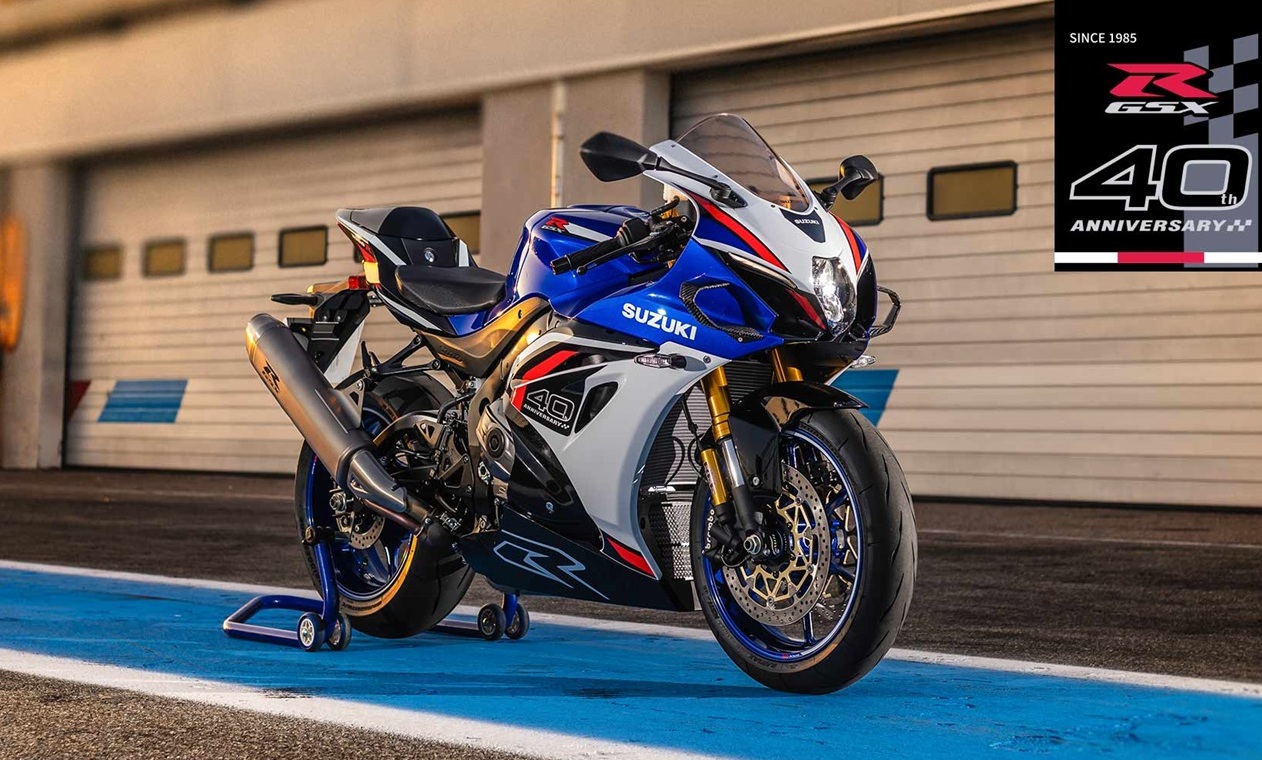
2027 Suzuki GSX-R1000R and GSX-R1000RS 40th Anniversary Edition
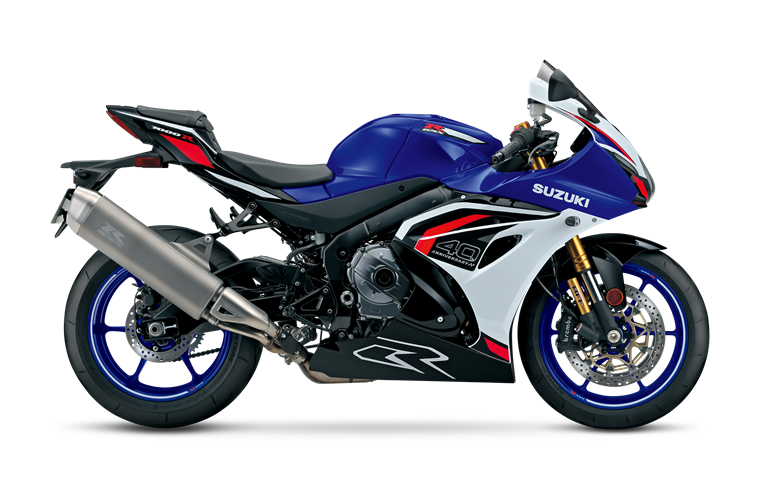
The Suzuki GSX-R1000R 40th Anniversary Edition and GSX-R1000RS 40th Anniversary Edition are 2027 model-year versions of Suzuki’s liter-class supersport motorcycle, introduced with special colors and graphics commemorating the 40th anniversary of the GSX-R family. Both motorcycles use the same updated 999.8 cc inline-four engine, aluminum twin-spar chassis, Showa BFF and BFRC-Lite suspension, Brembo front brakes, and Suzuki Intelligent Ride System (S.I.R.S.) electronic rider aids.
The two models are closely related mechanically. The principal distinction described in Suzuki’s product information is their standard equipment: the GSX-R1000RS is equipped with carbon-fiber front fairing winglets and a color-matched solo tail cowl, whereas the GSX-R1000R offers these items as accessories.
Background
The GSX-R family reached its 40th anniversary in 2025, while the GSX-R1000 had been in production for nearly a quarter of a century. Suzuki notes that GSX-R models arrived in the United States in 1986 and have been associated with production-based superbike, superstock, and endurance racing.
For 2027, Suzuki substantially updated the GSX-R1000 platform while retaining its four-cylinder, liter-class configuration. The revisions cover the engine, intake and exhaust systems, chassis, electronics, cooling system, and bodywork. Both Anniversary Edition models use the same fundamental package.
Model designation
The two motorcycles are identified as:
- GSX-R1000R 40th Anniversary Edition
- GSX-R1000RS 40th Anniversary Edition
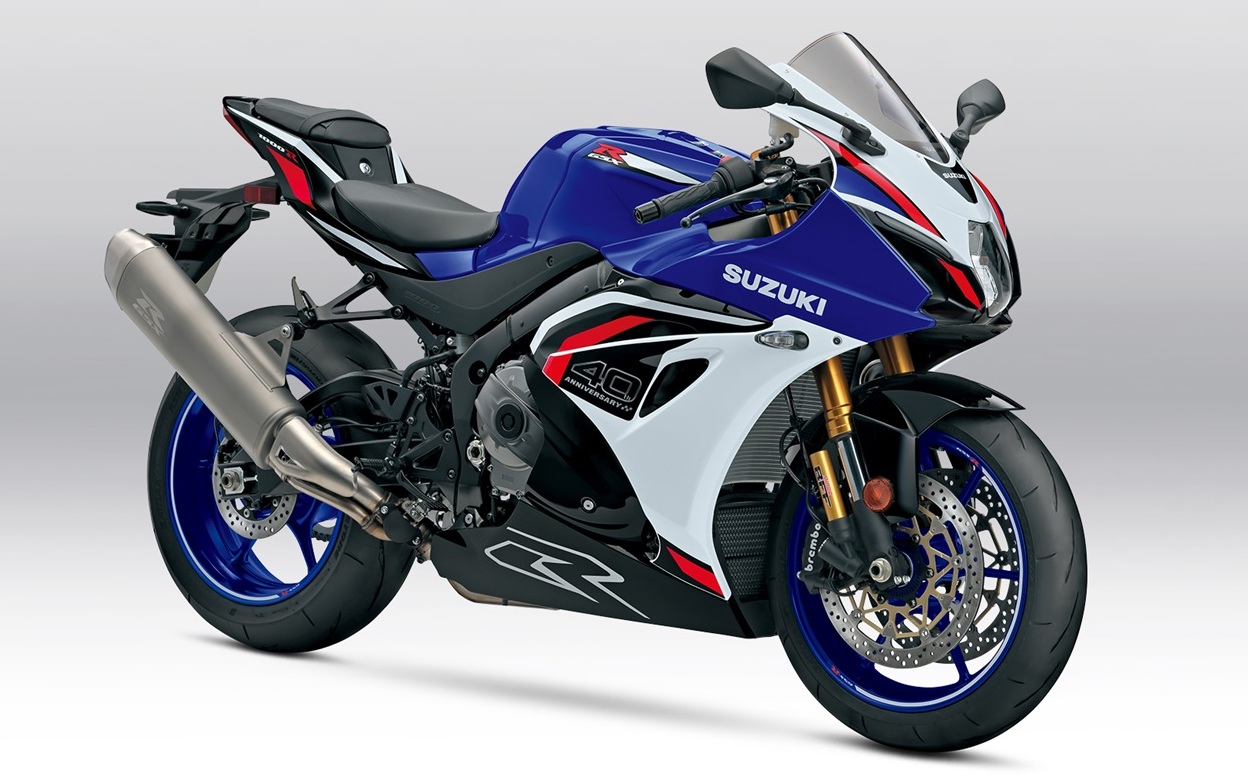
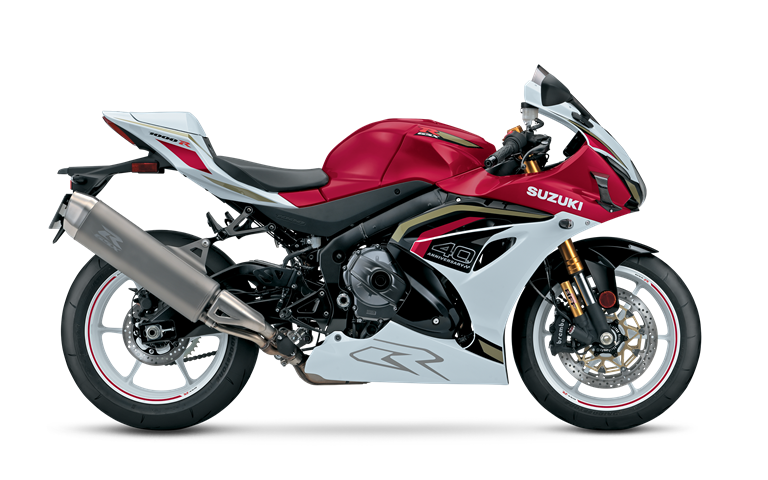
Both are offered in Pearl Vigor Blue / Pearl Tech White (C6F) and Candy Daring Red / Pearl Tech White (C7Q). The colors are based on racing liveries associated with notable GSX-R competition motorcycles from Suzuki’s history.
The Anniversary Edition treatment includes 40th anniversary decals on the fairing, an anniversary emblem on the fuel tank, black-finished fuel tank cap and mounting ring, an embossed GSX-R logo on the rider’s seat, special GSX-R graphics on the titanium muffler, gray-finished engine covers, gold-anodized front brake rotor carriers, and a custom ignition key bearing the GSX-R 40th anniversary logo.
Engine
Both models use a 999.8 cc, four-stroke, liquid-cooled, four-cylinder DOHC inline-four engine. The engine has a 76.0 mm bore and 55.1 mm stroke, giving it a short-stroke configuration suited to high engine speeds.
The compression ratio is 13.8:1, increased from 13.2:1 on the previous-generation GSX-R1000. Suzuki states that the change was made in conjunction with revised piston heads and larger exhaust valves to support power production.
The engine retains Suzuki’s Even Firing Order design. Titanium valves are used, with two 31.5 mm intake valves and two 25 mm exhaust valves per cylinder. The larger exhaust valves improve exhaust efficiency while also contributing to intake-air efficiency. The lightweight valve arrangement allows a 14,500 rpm redline.
The cylinder bores use Suzuki Composite Electrochemical Material (SCEM) coating, which is integrated into the upper crankcase. Suzuki describes the coating as reducing friction while improving heat transfer and durability.
The aluminum pistons have a 76.0 mm diameter and were developed using Finite Element Method analysis. Revised ribbing underneath the piston crowns reduces weight while increasing durability, while new piston circlips are intended to improve durability.
Revised cylinder head and valve train
For 2027, the cylinder head has revised intake and exhaust ports and a new head-gasket design. Camshaft valve lift and timing were optimized for the new engine output targets and emissions requirements. Maximum camshaft lift remains unchanged, while reduced valve overlap helps reduce emissions and improve acceleration.
A wider cam chain reduces frictional losses, particularly when using low-viscosity engine oil in sprint or endurance racing. The associated cam-chain drive and driven sprockets were redesigned to match the new chain.
The engine also receives a revised oil-delivery system intended to direct oil to the camshafts and valve train more efficiently while reducing oil windage.
Suzuki’s Suzuki Racing Variable Valve Timing System (SR-VVT) remains part of the engine. It uses a centrifugal mechanism on the intake camshaft sprocket to increase high-rpm power without sacrificing low- and mid-range performance.
The valve train uses Suzuki Racing Finger Followers rather than a conventional tappet-style arrangement. The finger followers are designed to reduce friction and improve valve response at high engine speeds, and each follower receives a Diamond-like Carbon (DLC) coating for reduced friction and improved durability.
Fuel injection and intake system
Both motorcycles use Ride-by-Wire electronic throttle bodies. Servo-controlled throttle valves provide precise throttle response while also helping stabilize idle speed and improve cold starting.
The fuel system combines four primary fuel injectors in the throttle bodies with four Suzuki Top Feed Injectors (S-TFI) mounted above the airbox. For 2027, the S-TFI injectors change from a 10-hole to an 8-hole design. Suzuki says the revision contributes to higher peak power, more efficient combustion, and more precise fuel control.
The airbox uses single-stage intake funnels on cylinders No. 1 and No. 4. Suzuki chose the simpler arrangement to maintain effective airflow across the engine-speed range without the additional weight and complexity of a more complicated mechanism.
The motorcycle also uses dual Suzuki Ram Air Direct (SRAD) intake ducts. The ducts are positioned near the center of the fairing nose, where air pressure is highest, and are larger because of the compact LED headlight arrangement.
Exhaust system
The 2027 GSX-R1000R and GSX-R1000RS receive an all-new 4-2-1 exhaust system. The collector is positioned closer to the engine to assist mass centralization and help the catalytic converters reach operating temperature more quickly.
The exhaust uses a media-blasted titanium muffler with a muted GSX-R logo. Its high mounting position provides ground clearance at high lean angles.
Suzuki reduced muffler volume from 8.3 liters to 5.5 liters while retaining the performance of the previous system. The exhaust also incorporates the Suzuki Exhaust Tuning (SET) system and SET-Alpha valves. These systems regulate exhaust flow and back pressure to broaden power delivery and reduce exhaust sound without requiring a larger silencer.
Cooling system
The cooling system was redesigned using advanced analysis to improve coolant flow through the engine and radiator. The 2027 system uses 400 cc less coolant than the previous-generation GSX-R1000, reducing weight while improving cooling efficiency.
Cooling air is directed through the fairing toward a high-capacity curved radiator, while twin cooling fans assist cooling at lower road speeds. An air-cooled, radiator-style oil cooler is mounted below the main radiator to remove additional heat from the engine.
Transmission and clutch
Both Anniversary Edition models use a six-speed constant-mesh transmission and a wet, multi-plate clutch incorporating Suzuki’s Suzuki Clutch Assist System (SCAS).
SCAS functions similarly to a slipper clutch during downshifts, helping smooth engine braking, while increasing pressure on the clutch plates during acceleration. The system also reduces clutch-lever effort.
The cassette-style transmission can be removed from the crankcase as an assembly while the engine remains in the frame. This arrangement simplifies racetrack gear-ratio changes and service.
The transmission uses vertically staggered shafts to reduce overall engine length. The shift linkage can be configured for reverse-pattern, GP-style shifting, including when the quick shifter is being used. A programmable shift light alerts the rider when the selected engine-speed threshold is reached.
The primary gear ratio is lower than that of the previous-generation GSX-R1000 to assist acceleration. Final drive uses a 525-size DID chain with a 45/17 final sprocket ratio.
Bi-directional quick shifter
The Suzuki Bi-directional Quick Shift System permits clutchless upshifts and downshifts.
During an upshift, the system briefly interrupts engine power for approximately 50 to 75 milliseconds, depending on the sensitivity setting, allowing the transmission dogs to unload for a clean shift.
During downshifts, the electronic throttle valves open slightly to raise engine speed and match the lower gear. The automatic throttle-blipping function works together with engine braking to provide smoother downshifts.
Chassis
The motorcycles use a lightweight aluminum twin-spar frame developed using Finite Element Method analysis. Suzuki states that the frame is approximately 10 percent lighter than the previous-generation GSX-R1000 frame.
The frame spars are positioned 20 mm closer together, contributing to aerodynamics, appearance, and rider comfort.
The engine has been rotated six degrees backward compared with the previous GSX-R1000. This reduces the fork-to-center distance by 20 mm and increases swingarm length by 40 mm. Suzuki developed the arrangement using lessons from its MotoGP chassis work, with the goal of improving chassis handling and aerodynamic characteristics.
The Superbike-style aluminum swingarm uses equalized bracing between its main beams. Suzuki says this provides balanced support and movement of the shock absorber while producing consistent suspension feedback.
The swingarm pivot is adjustable to allow chassis tuning for track use. Suzuki specifies that the standard pivot position should be used for street riding.
Suspension
Both motorcycles are equipped with Showa suspension components developed with racetrack technology.
At the front is the Showa Balance Free Front Fork (BFF). The system controls damping force outside the spring chamber, allowing the fork to maintain consistent damping characteristics throughout its stroke.
At the rear is a Showa Balance Free Rear Cushion Light (BFRC-Lite) shock connected to the swingarm through racetrack-developed linkage. The design controls damping force outside the shock body and is intended to provide controlled suspension movement over uneven surfaces and during braking.
The BFF is paired with a lightweight, race-ready upper triple clamp.
Brakes
The front braking system uses Brembo four-piston Monobloc radial-mount calipers and dual 320 mm Brembo T-drive floating brake rotors.
The front brake rotors use both conventional floating rotor spools and T-drive fasteners. Suzuki states that the combination allows the rotor to absorb more braking energy than a disc using conventional floating spools alone.
The rear brake uses a 240 mm disc with a Nissin single-piston caliper. Stainless-steel brake lines are fitted to the front brake system.
For 2027, the ABS control unit is more compact and lighter, with a weight reduction of approximately 51 grams compared with the previous component.
The Motion Track Brake System uses the IMU together with wheel-speed information to regulate braking pressure according to motorcycle posture. It can operate when the motorcycle is leaned over as well as during straight-line braking.
The system is designed to help maintain the motorcycle’s intended line during braking in a corner and to help manage chassis pitch when rear-wheel lift is detected.
Wheels and tires
Both models use lightweight six-spoke wheels designed to reduce unsprung mass and help manage braking and drive forces.
The standard tires are Bridgestone Racing Street RS11 tires. Suzuki describes the RS11 as a track-day-ready tire with a tread pattern designed to reduce wear while maintaining sport performance and contact feel.
Suzuki Intelligent Ride System
The 2027 GSX-R1000R and GSX-R1000RS use Suzuki’s revised Suzuki Intelligent Ride System (S.I.R.S.).
A new lightweight Bosch Inertial Measurement Unit (IMU) provides six-direction, three-axis motion and position information to the engine control module. The information allows the motorcycle’s electronic systems to make instantaneous adjustments to engine and chassis functions.
The S.I.R.S. package includes:
- Suzuki Drive Mode Selector (SDMS)
- Smart TLR Control
- Suzuki Traction Control System (STCS)
- Lift Limiter
- Roll Torque Control
- Launch Control
- Ride-by-Wire Electronic Throttle System
- Bi-directional Quick Shift System
- Motion Track Brake System
- Slope Dependent Control System
- Suzuki Easy Start System
- Low RPM Assist
Suzuki Drive Mode Selector
The rider can choose from three engine-response modes:
Mode A (Active) provides the sharpest throttle response and is intended for sporty riding, track days, and clear-weather riding on winding roads.
Mode B (Basic) provides softer throttle response and a more linear power-delivery characteristic for general riding.
Mode C (Comfort) provides the softest throttle response and gentler torque characteristics. Suzuki describes it as suitable for wet or slippery surfaces, passenger use, or relaxed riding.
All three modes retain the motorcycle’s peak engine output; they primarily alter the characteristics of power delivery.
Smart TLR Control
Smart TLR Control coordinates the Lift Limiter and Roll Torque Control with the selected Suzuki Traction Control System setting. Changing the traction-control setting automatically changes the responses of the two supporting systems.
Suzuki Traction Control System
The STCS offers 10 intervention levels plus OFF.
Lower settings provide less intervention, while higher settings make the system more proactive in limiting rear-wheel spin. The system monitors wheel speeds, engine rpm, throttle position, gear position, and lean angle information from the IMU.
When a loss of traction is anticipated, the ECM can control the electronic throttle, ignition coil, and spark plugs to reduce engine output.
Lift Limiter
The Lift Limiter helps maintain front-wheel contact during hard acceleration. Its response is coordinated with the selected traction-control setting.
The ECM evaluates engine rpm, throttle position, gear position, clutch status, wheel speeds, and IMU information before adjusting electronic throttle opening to limit the potential for excessive front-wheel lift.
Roll Torque Control
Roll Torque Control uses information from the IMU and wheel-speed sensors to calculate lean angle and speed and determine an appropriate level of engine output while the motorcycle is cornering.
It operates together with the traction-control system to provide predictable power delivery through corners.
Launch Control
The Launch Control system is designed for closed-course competition. It automatically manages engine rpm and torque delivery while the rider concentrates on operating the clutch during a start.
The system monitors throttle position, throttle-valve position, engine rpm, gear position, and front and rear wheel speeds. It disengages automatically when the rider shifts into third gear or closes the throttle.
Motion Track Brake System
The Motion Track Brake System combines ABS with IMU information to control braking when the motorcycle is upright or leaned into a corner.
The ABS unit monitors front and rear wheel speeds and motorcycle posture. When necessary, hydraulic pressure is adjusted to reduce the effect of sudden braking and help maintain the motorcycle’s radius and lean angle through a corner.
Slope Dependent Control System
The Slope Dependent Control System helps manage rear-wheel lift during downhill braking. The ABS system uses IMU information to determine motorcycle posture and continuously adjusts brake pressure according to the slope angle.
Suzuki Easy Start and Low RPM Assist
Suzuki Easy Start allows the ECM to crank the engine for up to 1.5 seconds, or until the engine starts, after a momentary press of the starter button. When the transmission is in neutral, the clutch does not need to be pulled in.
Low RPM Assist monitors engine rpm, gear position, throttle position, and clutch-switch information to help prevent engine speed from dropping excessively when starting from rest or riding at low speed. The system is also intended to make stop-and-go traffic and U-turns easier.
Electronics and instrumentation
A 32-bit dual-processor Engine Control Module supports the S.I.R.S. systems. A Controller Area Network (CAN Bus) separates the electronic communication wiring from the main harness, allowing rapid communication among the motorcycle’s electronic systems.
Both motorcycles use a lithium-ion battery that is lighter and more compact than a conventional battery and provides more stable voltage under load. The HY battEliiy P-series battery is described as having an expected lifespan of approximately 10 years.
The instrument panel is a black-background LCD display inspired by the GSX-RR MotoGP dashboard. It provides the tachometer, speedometer, and other operating information, with adjustable brightness and associated warning and indicator lights.
The lighting system includes a compact stacked LED headlight, arched LED position lights, an LED combination tail/brake light, LED turn signals, and LED license-plate illumination.
Aerodynamic bodywork
The 2027 GSX-R1000R/RS bodywork was developed using multiple wind-tunnel tests. Suzuki describes the new shape as narrower than before, with the aerodynamic design intended to contribute to handling and racetrack top speed.
The compact LED headlight allows the dual SRAD intake ducts to be positioned close to the center of the fairing nose. The under-cowl panels were also revised to accommodate the new exhaust system, including a smooth left-side panel where the previous model had an opening.
The top of the fuel tank is 21 mm lower than on the previous-generation GSX-R1000, making it easier for the rider to tuck behind the front fairing and windshield.
The seat height is 825 mm (32.48 inches). The rider controls can be adjusted in relation to the footrests and grips, while the shifter and rear brake pedal are adjustable in relation to the footrests.
40th Anniversary Edition equipment
The Anniversary Edition models share the same special color schemes and commemorative detailing. The major equipment distinction between the R and RS versions concerns the aerodynamic winglets and solo tail cowl.
GSX-R1000R
On the GSX-R1000R, the new carbon-fiber front fairing winglets are listed as an optional accessory. The passenger seat can likewise be removed and replaced with an optional color-matched solo tail cowl available through Suzuki dealers.
GSX-R1000RS
The GSX-R1000RS comes with the carbon-fiber winglets already installed. Their design is inspired by the GSX-R1000R-based CN Challenge motorcycle used in the Suzuka 8 Hours endurance race.
The RS also includes a color-matched solo tail cowl, allowing the passenger seat to be replaced for solo riding.
Differences between the GSX-R1000R and GSX-R1000RS
| Feature | GSX-R1000R 40th Anniversary Edition | GSX-R1000RS 40th Anniversary Edition |
|---|---|---|
| Engine | 999.8 cc inline-four | 999.8 cc inline-four |
| Compression ratio | 13.8:1 | 13.8:1 |
| Transmission | 6-speed | 6-speed |
| Quick shifter | Bi-directional | Bi-directional |
| Frame | Aluminum twin-spar | Aluminum twin-spar |
| Front suspension | Showa BFF | Showa BFF |
| Rear suspension | Showa BFRC-Lite | Showa BFRC-Lite |
| Front brakes | Brembo 4-piston, 320 mm T-drive | Brembo 4-piston, 320 mm T-drive |
| Rear brake | Nissin single-piston | Nissin single-piston |
| IMU/S.I.R.S. | Yes | Yes |
| Traction control | 10 levels + OFF | 10 levels + OFF |
| Launch control | Yes | Yes |
| Wheel/tire specification | Same | Same |
| Fuel capacity | 16.0 L | 16.0 L |
| Seat height | 825 mm | 825 mm |
| Curb weight | 203 kg | 203 kg |
| Carbon-fiber winglets | Optional accessory | Included |
| Solo tail cowl | Optional accessory | Included |
| Warranty | 12-month unlimited mileage | 12-month unlimited mileage |
Dimensions and specifications
| Specification | GSX-R1000R / GSX-R1000RS |
| Engine type | 4-stroke, liquid-cooled, 4-cylinder, DOHC |
| Displacement | 999.8 cc |
| Bore × stroke | 76.0 × 55.1 mm |
| Compression ratio | 13.8:1 |
| Fuel system | Fuel injection, Ride-by-Wire throttle bodies |
| Starter | Electric |
| Lubrication | Wet sump |
| Clutch | Wet, multi-plate |
| Transmission | 6-speed constant mesh |
| Final drive | Chain, DID 525HV3, 120 links |
| Front suspension | Inverted telescopic, coil spring, oil damped |
| Rear suspension | Link type, single shock, coil spring, oil damped |
| Front brake | Brembo 4-piston, twin disc, ABS |
| Rear brake | Nissin 1-piston, single disc, ABS |
| Front tire | 120/70ZR17M/C (58W), tubeless |
| Rear tire | 190/55ZR17M/C (75W), tubeless |
| Fuel capacity | 16.0 L (4.2 US gal.) |
| Headlight | LED |
| Tail light | LED |
| Overall length | 2,075 mm |
| Overall width | 705 mm |
| Overall height | 1,145 mm |
| Wheelbase | 1,420 mm |
| Ground clearance | 130 mm |
| Seat height | 825 mm |
| Curb weight | 203 kg |
| Warranty | 12-month unlimited mileage limited warranty |
Availability and warranty
Suzuki lists a 12-month unlimited-mileage limited warranty for both the GSX-R1000R and GSX-R1000RS. Longer coverage periods and additional benefits are available through the Suzuki Extended Protection (SEP) program. Suzuki also lists Genuine Suzuki Accessories and GSX-R-branded apparel.
Summary
The 2027 GSX-R1000R 40th Anniversary Edition and GSX-R1000RS 40th Anniversary Edition represent the same updated 2027 GSX-R1000 platform with Suzuki’s 40th anniversary styling.
Both use the 999.8 cc liquid-cooled inline-four engine, 14,500-rpm redline, 13.8:1 compression ratio, Ride-by-Wire throttle bodies, SR-VVT, SCAS clutch, six-speed transmission, bi-directional quick shifter, aluminum twin-spar frame, Showa BFF/BFRC-Lite suspension, Brembo radial Monobloc brakes, Motion Track ABS, Bosch IMU, and the full S.I.R.S. electronic rider-aid package.
The clearest difference is equipment. The GSX-R1000R treats the carbon-fiber winglets and color-matched solo tail cowl as optional accessories, while the GSX-R1000RS includes both items as standard equipment. No separate engine output, chassis specification, dimensional difference, or curb-weight difference is given for the RS.
For that reason, the GSX-R1000RS can be described most accurately from the supplied material as a more fully equipped version of the 40th Anniversary GSX-R1000R rather than as a substantially different mechanical variant.