Of course, here is the full article about the 2018–2023 Harley-Davidson Softail Fat Bob 114, written in the requested style and format.
The 2018–2023 Harley-Davidson Softail Milwaukee-Eight 114 (FXFBS Fat Bob 114) is a performance cruiser motorcycle that marked a significant pivot in Harley-Davidson’s product strategy. Introduced as part of the completely redesigned Softail lineup for the 2018 model year, the Fat Bob 114 blended aggressive, non-traditional styling with a new chassis and the powerful Milwaukee-Eight engine. It was designed to appeal to a rider seeking a muscular stance, strong performance, and more dynamic handling than what was typically expected from a Harley-Davidson cruiser.
A Departure from the Dyna Legacy
Prior to 2018, the Fat Bob was a popular model within Harley-Davidson’s Dyna family, which was characterized by its traditional frame design and twin external rear shock absorbers. The 2018 model year saw the complete consolidation of the Dyna and Softail lines into a single, unified platform. This move was controversial among some brand purists but was driven by a need to modernize the chassis technology.
The new Softail frame was significantly stiffer and lighter than the outgoing Dyna and Softail frames it replaced. The most prominent change was the move to a hidden rear monoshock absorber located beneath the seat. This design preserved the classic “hardtail” look of the Softail line while providing the performance benefits of a modern suspension system, including increased travel and easier preload adjustment. For the Fat Bob, this translated into a dramatic improvement in handling, cornering clearance, and overall ride quality compared to its Dyna predecessor.
Powertrain and Performance
At the heart of the Fat Bob 114 is the Milwaukee-Eight 114 engine. This 114 cubic inch (1868cc), 45-degree V-Twin is air and oil-cooled and features four valves per cylinder. A key feature of the Milwaukee-Eight engine is its dual internal counter-balancers, which quell a significant amount of the engine’s primary vibration. This smoothness allowed Harley-Davidson to rigidly mount the engine in the new Softail frame, making it a stressed member and contributing to the chassis’s overall stiffness without transferring excessive vibration to the rider.
The engine is tuned for strong low-end and mid-range torque, providing brisk acceleration from a stop and ample power for highway overtaking. It is paired with a 6-speed Cruise Drive transmission, delivering power to the rear wheel via a carbon-fiber reinforced belt drive.
Design, Chassis, and Styling of the FXFBS Fat Bob 114
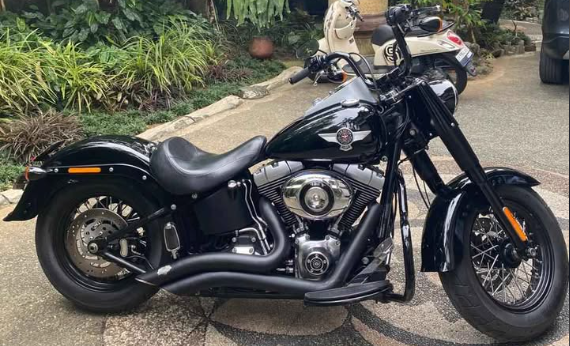
The styling of the 2018–2023 Fat Bob 114 is arguably its most defining characteristic. It deviates sharply from traditional chrome-laden cruiser aesthetics, instead adopting a stripped-down, muscular, and almost post-apocalyptic look.
Key visual elements include:
Front End: A distinctive, horizontal LED headlight sits within a modern nacelle, flanked by performance-oriented inverted front forks, a feature more common on sport bikes than cruisers.
Wheels and Tires: The bike rides on chunky, aggressive-tread tires mounted on cast-aluminum wheels, reinforcing its powerful stance.
Exhaust: A custom-styled 2-1-2 upswept exhaust with a bronze or satin chrome finish adds to the bike’s performance-oriented and unconventional appearance.
* Ergonomics:** A flat, drag-style handlebar and forward foot controls create an aggressive, commanding riding position.
The chassis complements the powerful engine with components chosen for performance. The inverted front forks provide improved steering response and front-end feel, while the easily adjustable rear monoshock allows the rider to tune the suspension for load or riding style. Braking is handled by dual disc brakes on the front wheel, providing strong, confident stopping power. Throughout its 2018–2023 production run, the model saw minimal mechanical changes, with updates primarily limited to paint schemes and graphics. For example, the 2022 model year saw a change in the fuel tank graphic from the “H-D” logo to a more traditional “Harley-Davidson” script.
Specifications Table
| General | |
| Brand | Harley-Davidson |
| Model | Fat Bob 114 |
| Model Class | Softail |
| Model Year | 2018–2023 |
| Type | Performance Cruiser |
| Maximum mass (GVWR) | 1160 lb. (526 kg) |
| Maximum passengers | 2 |
| Performance | |
| Max. power | ~94 Hp (70 Kw) / 5020 RPM |
| Max. torque | 118 ft-lb (160 N•m) / 3500 RPM |
| Lean Angle (Right/Left) | 31° / 32° |
| Top designed speed | ~110 mph (177 km/h) |
| Size | |
| Length | 92.1 in. (2340 mm) |
| Width | 37.8 in. (960 mm) |
| Height | 44.1 in. (1120 mm) |
| Wheelbase | 63.6 in. (1615 mm) |
| Seat height (laden) | 27.7 in. (704 mm) |
| Ground clearance | 4.7 in. (120 mm) |
| Curb weight (in running order) | 675 lb. (306 kg) |
| Engine | |
| Type | Milwaukee-Eight 114, 45° V-Twin, Four Stroke, Air/Oil-Cooled |
| Displacement | 114 cu in (1868 cc) |
| Bore × Stroke | 4.016 in. × 4.5 in. (102 mm × 114.3 mm) |
| Compression ratio | 10.5:1 |
| Starting system | Electric starter |
| Fuel supplying system | Electronic Sequential Port Fuel Injection (ESPFI) |
| Ignition control system | ECU Ignition |
| Lubricating system | Dry sump, pressure lubrication |
| Oil capacity | With filter: 5 qt (4.7 L) |
| Engine oil type | SAE 20W-50 Harley-Davidson H-D 360 Motorcycle Oil |
| Transmission | |
| Transmission type | 6-speed, manual gear shift (Cruise Drive) |
| Clutch type | Wet, multi-disc, mechanically actuated |
| Driving system | Belt drive, 32/66 ratio |
| Primary reduction ratio | 1.917 (Chain, 34/46 ratio) |
| Gear ratio | 1st: 9.311; 2nd: 6.454; 3rd: 4.793; 4th: 3.882; 5th: 3.307; 6th: 2.790 |
| Chassis | |
| Tire size | Front: 150/80-16; Rear: 180/70B16 |
| Rim size | Front: 16 in. x 3 in.; Rear: 16 in. x 5 in. (Cast Aluminum) |
| Capacity of fuel tank | 3.5 gal (13.2 L) |
| Fuel consumption (est.) | 47 MPG (5.0 L / 100 km) |
| Electric | |
| Battery | 12V, sealed, maintenance-free, 310 cca |
| Headlight | LED Daymaker Signature |
| Tail/Brake light | LED |
| Turning light | LED |
| Suspension | |
| Front suspension | Inverted single cartridge 43 mm fork with triple-rate springs |
| Front travel | 5 in (127 mm) |
| Rear suspension | Hidden, free piston, coil-over monoshock; 56mm stroke |
| Rear travel | 4.4 in (112 mm) |
| Rear spring preload | Tool-less hydraulic adjustment via external knob |