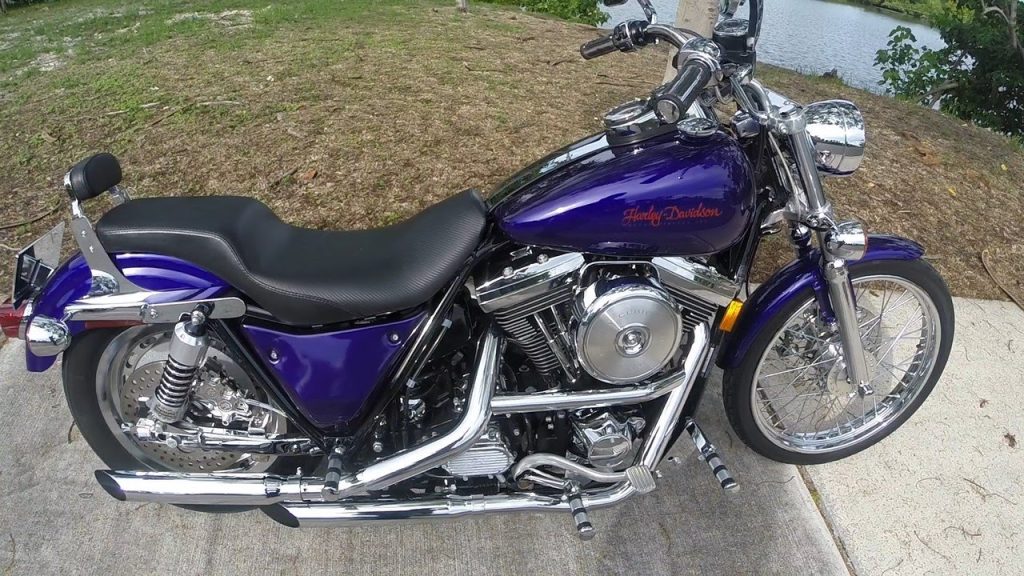
Of course, here is a full article about the 1994–1998 Harley-Davidson Touring Evolution 1340 (FLHR Road King).
The 1994–1998 Harley-Davidson Touring Evolution 1340 (FLHR Road King) represents a pivotal era for the Milwaukee-based manufacturer, marking the introduction of one of its most iconic and enduring models. Launched in 1994, the Road King was developed to meet the growing demand for a versatile, large-displacement touring motorcycle that blended modern performance with nostalgic, post-war styling. It effectively replaced the FLHS Electra Glide Sport, offering a more stripped-down and classic aesthetic that immediately resonated with riders in North America and beyond. This new model successfully bridged the gap between the fully-dressed touring bikes like the Electra Glide Ultra Classic and the more minimalist cruisers in the Harley-Davidson lineup.
History and Development
The introduction of the FLHR Road King in 1994 was a strategic move by Harley-Davidson. The preceding model, the FLHS Electra Glide Sport, was essentially a base Electra Glide without the full “batwing” fairing. While functional, it lacked a distinct identity. The Road King was a ground-up reimagining of this concept, designed with a clear “neo-classic” vision. It drew inspiration from the classic FL models of the 1940s and 1950s, particularly with its large, detachable windshield and prominent “Hiawatha” headlamp nacelle. This design offered riders the best of both worlds: full wind protection for long-distance travel and a clean, cruiser profile when the windshield was removed.
The core of the Road King’s appeal was its ability to serve as a convertible tourer. It came standard with features essential for long hauls, such as lockable, color-matched hard saddlebags, a comfortable two-up seat, and floorboards for the rider. However, its design was clean enough that with the windshield detached, it transformed into a formidable boulevard cruiser. This versatility was a key differentiator from its predecessor and a major factor in its immediate success.
Drivetrain: The 1994–1998 Harley-Davidson Touring Evolution 1340 (FLHR Road King) Engine
At the heart of this machine was the legendary 1340cc (80 cubic inch) Evolution V-twin engine. Introduced in 1984, the “Evo” was a significant leap forward in reliability and performance compared to the older Shovelhead engine. It featured aluminum cylinders and heads over cast-iron, which improved cooling and allowed for tighter manufacturing tolerances. By the time it was fitted to the Road King in 1994, the Evolution engine had earned a solid reputation for its durability and characteristic torque delivery.
For most of this production run, the engine was fed by a 40mm Keihin constant velocity (CV) carburetor, which provided smooth throttle response and reliable performance. In 1995, Harley-Davidson introduced sequential port electronic fuel injection (EFI) as an option, appealing to riders who preferred the convenience of easier cold starts and automatic altitude compensation. The engine was paired with a 5-speed transmission, and power was delivered to the rear wheel via a clean and low-maintenance belt drive system, a hallmark of modern Harley-Davidson motorcycles.
Chassis and Model Year Changes
The Road King was built on Harley-Davidson’s robust touring frame, designed to provide stability and comfort over long distances, even when fully loaded. The front suspension consisted of traditional telescopic forks, while the rear featured dual air-adjustable shock absorbers. This allowed riders to fine-tune the suspension preload based on the weight of a passenger or luggage, enhancing ride quality and handling.
Throughout its initial five-year run, the Evolution-powered Road King saw several refinements:
1994: The FLHR Road King is officially launched. It is an immediate success and sets the standard for retro-styled touring motorcycles.
1995: Electronic Fuel Injection (EFI) becomes an optional feature, designated as FLHRI. This marked a significant technological advancement for the touring line.
1996: A new, more robust wiring harness was introduced, improving the motorcycle’s electrical reliability. The FLHRCI Road King Classic was also introduced, featuring leather-covered hard saddlebags and wire-spoke wheels for an even more nostalgic look.
1997: Minor updates and refinements were made across the touring line.
1998: This was the final year for the Evolution 1340 engine in the touring family. The model received minor cosmetic updates before the entire line was transitioned to the new Twin Cam 88 engine for the 1999 model year. This makes the 1998 models the last and most refined of the Evo-powered Road Kings.
Specifications
| <td colspan=”2″ style=”text-align:center; background-color:#f2f2f2;”><b>General</b></td> |
| :— | :— |
| Brand | Harley-Davidson |
| Model | Road King |
| Model Class | FLHR |
| Model Year | 1994–1998 |
| Type | Touring |
| Maximum mass (GVWR) | 1,259 lb. (571 kg) |
| Maximum passengers | 2 |
| <td colspan=”2″ style=”text-align:center; background-color:#f2f2f2;”><b>Performance</b></td> |
| Max. power (est.) | ~60 Hp / 5000 RPM |
| Max. torque (est.) | ~70 ft-lb (95 N•m) / 2400 RPM |
| Top designed speed | ~105 mph (169 km/h) |
| <td colspan=”2″ style=”text-align:center; background-color:#f2f2f2;”><b>Size</b></td> |
| Length | 93.7 in. (2380 mm) |
| Width | 34.5 in. (876 mm) |
| Height | 56.7 in. (1440 mm, with windshield) |
| Wheelbase | 62.7 in. (1592 mm) |
| Seat height | 28.2 in. (716 mm) |
| Ground clearance | 5.1 in. (130 mm) |
| Curb weight | ~765 lb. (347 kg) |
| <td colspan=”2″ style=”text-align:center; background-color:#f2f2f2;”><b>Engine</b></td> |
| Type | 45-degree V-Twin, Air-Cooled, Four Stroke, OHV |
| Displacement | 1340 cc (80 cubic inches) |
| Bore × Stroke | 3.498 in. × 4.250 in. (88.8 mm × 108 mm) |
| Compression ratio | 8.5:1 |
| Starting system | Electric starter |
| Fuel supplying system | 40mm Keihin CV Carburetor (Standard) / EFI (Optional 1995+) |
| Ignition control system | Electronic |
| Lubricating system | Dry-sump |
| Oil capacity | 4.0 qt (3.8 L) |
| Engine oil type | SAE 20W-50 |
| <td colspan=”2″ style=”text-align:center; background-color:#f2f2f2;”><b>Transmission</b></td> |
| Transmission type | 5-speed, manual gear shift |
| Clutch type | Wet, multi-disc, manual |
| Driving system | Belt drive |
| Primary reduction ratio | 1.500 |
| Final reduction ratio | 2.187 |
| Gear ratio | 1st: 3.21; 2nd: 2.21; 3rd: 1.57; 4th: 1.23; 5th: 1.00 |
| <td colspan=”2″ style=”text-align:center; background-color:#f2f2f2;”><b>Chassis</b></td> |
| Tire size | Front: MT90B16; Rear: MT90B16 |
| Rim size | Front: 16 in.; Rear: 16 in. |
| Capacity of fuel tank | 5.0 gal (19 L) |
| Fuel consumption | ~42 mpg (5.6 L / 100 km) |
| <td colspan=”2″ style=”text-align:center; background-color:#f2f2f2;”><b>Electric</b></td> |
| Battery | 12V / 19 Ah |
| Headlight | Incandescent |
| Tail light | Incandescent |
| <td colspan=”2″ style=”text-align:center; background-color:#f2f2f2;”><b>Shock Absorbers</b></td> |
| Front travel | 4.6 in (117 mm) |
| Rear travel | 3.0 in (76 mm) |
| Front Suspension | Telescopic fork |
| Rear Suspension** | Dual shocks, air-adjustable preload |