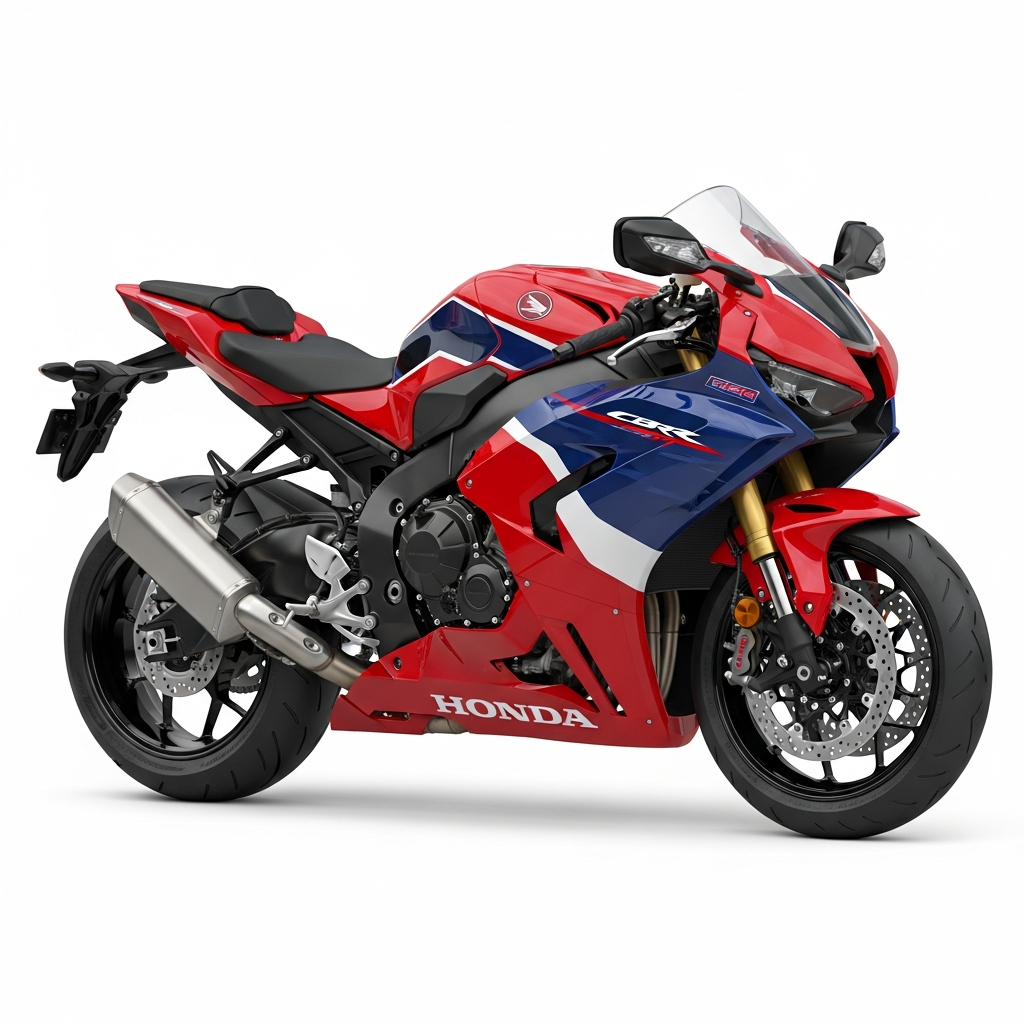
The 2026 Honda CBR1000RR, marketed in its highest specification as the CBR1000RR-R Fireblade SP, represents the latest evolution of Honda’s legendary flagship superbike. Engineered with a singular focus on circuit performance while retaining the “Total Control” philosophy that has defined the Fireblade lineage since its inception, the 2026 model introduces a series of targeted refinements over its predecessor. Building on the highly successful platform that was heavily updated in previous years, this iteration focuses on enhancing aerodynamic efficiency, refining engine power delivery, and integrating a more advanced electronics suite to push the boundaries of performance for both professional racers and track-day enthusiasts.
Development and Design Philosophy
For the 2026 model year, Honda’s Racing Corporation (HRC) engineers aimed to extract more performance not through a complete overhaul, but through meticulous optimization. The core objective was to improve corner-exit drive and high-speed stability. This was a direct response to feedback from Honda’s World Superbike (WSBK) teams and analysis of competitor advancements.
The design language continues its aggressive, MotoGP-inspired theme, but with significant aerodynamic updates. While the previous model featured a highly effective winglet package, the 2026 version debuts a second-generation integrated aerodynamic system. This new design features a more seamless integration of the winglets into the main fairing, reducing turbulent air around the rider’s arms and legs. Furthermore, subtle changes to the shape of the tail unit and lower fairing are designed to improve laminar flow and reduce the overall coefficient of drag, providing a tangible benefit on long straights.
Engine and Performance Refinements
The heart of the Fireblade remains its 999cc liquid-cooled inline-four engine, known for its high-revving, short-stroke architecture derived from the RC213V MotoGP prototype. For 2026, the engine receives key internal updates aimed at broadening the torque curve without sacrificing its impressive peak power output.
Key differences from the previous model include:
Revised Camshafts and Valve Timing: New profiles are utilized to increase mid-range torque between 6,000 and 10,000 RPM, making the bike more manageable and faster when accelerating out of corners.
Lighter Internal Components: The use of new, lighter-weight titanium connecting rods and forged aluminum pistons reduces reciprocating mass, allowing the engine to rev more freely and improving throttle response.
Updated Intake and Exhaust Systems:** The airbox volume has been optimized, and the 4-2-1 exhaust system features revised collector dimensions and a new catalytic converter design to enhance gas flow while meeting stringent emissions standards.
While peak horsepower sees a modest increase, the primary achievement is a more linear and accessible powerband, empowering riders to apply the throttle with greater confidence.
Chassis and Electronics of the 2026 Honda CBR1000RR
The 2026 Honda CBR1000RR continues to use the proven aluminum twin-spar “Diamond” frame, but with revised rigidity characteristics. Engineers have slightly reduced lateral stiffness to provide more chassis flex and rider feedback during maximum lean angles. The swingarm, also derived from the RC213V, has been marginally lengthened to improve rear-wheel traction under hard acceleration.
The SP model is equipped with the latest generation of Öhlins Smart Electronic Control (S-EC 3.0) suspension. This semi-active system uses a new 6-axis IMU and advanced algorithms to adjust damping in real-time based on speed, lean angle, acceleration, and braking forces. New for 2026 is a “Track Pro” setting, which offers a more aggressive and responsive damping profile specifically for circuit use.
The electronics suite sees a significant upgrade with a more powerful processor. The Honda Selectable Torque Control (HSTC) is now more refined, with nine levels of intervention that feel less intrusive. The system also includes multi-level Slide Control, Wheelie Control, and Engine Brake Management, all fully customizable through a new, larger, and brighter full-color TFT display. This new interface offers improved readability in direct sunlight and features intuitive navigation via revised switchgear on the left handlebar.
Technical Specifications
| Brand | Honda |
| Model | CBR1000RR |
| Model Class | CBR1000RR-R Fireblade SP |
| Model Year | 2026 |
| Type | Superbike / Sport |
| General | |
| Maximum mass | 837.8 lb. (380 kg) |
| Maximum passengers | 2 (with optional passenger seat) |
| Performance | |
| Max. power | 218 Hp (162.5 Kw) / 14,000 RPM |
| Max. torque | 84 ft-lb (114 N•m) / 12,000 RPM |
| Min. turn diameter | 22.3 ft (6.8 m) |
| Top designed speed | 186 mph (299 km/h) (electronically limited) |
| Size | |
| Length | 82.9 in. (2105 mm) |
| Width | 29.3 in. (745 mm) |
| Height | 45.1 in. (1145 mm) |
| Wheelbase | 57.3 in. (1455 mm) |
| Seat height | 32.7 in. (831 mm) |
| Ground clearance | 4.5 in. (115 mm) |
| Curb weight | 441 lbs. (200 kg) |
| Engine | |
| Type | Inline-Four Cylinder, Four Stroke, Liquid Cooled, DOHC |
| Displacement | 999 cc |
| Bore × Stroke | 3.19 in. × 1.90 in. (81 mm × 48.5 mm) |
| Compression ratio | 13.6:1 |
| Starting system | Electric starter |
| Fuel supplying system | PGM-DSFI (Programmed Dual Stage Fuel Injection) |
| Ignition control system | ECU Ignition |
| Lubricating system | Forced pressure and Wet sump |
| Oil capacity | When changing an oil filter: 4.2 qt (4.0 L) |
| Engine oil type | SAE 10W-40 JASO T903 MA |
| Coolant capacity | 3.4 L |
| Coolant type | Honda Pro HP Coolant |
| Idle speed | 1300 RPM ± 100 RPM |
| Transmission | |
| Transmission type | 6-speed, manual, with Quickshifter |
| Clutch type | Wet, multi-disc, slipper/assist clutch |
| Driving system | Chain drive |
| Primary reduction ratio | 1.975 |
| Final reduction ratio | 2.687 |
| Gear ratio | 1st: 2.538; 2nd: 2.055; 3rd: 1.736; 4th: 1.521; 5th: 1.363; 6th: 1.238 |
| Chassis | |
| Tire size | Front: 120/70 ZR17 M/C; Rear: 200/55 ZR17 M/C |
| Rim size | Front: 17M/C × MT3.50; Rear: 17M/C × MT6.00 |
| Capacity of fuel tank | 4.3 gal (16.5 L) |
| Fuel consumption | ≈35 mpg (6.7 L / 100 km) |
| Electric | |
| Battery | 12V / 7 Ah (Lithium-ion) |
| Headlight | LED |
| Position Light | LED |
| Turning light | LED |
| Tail light | LED |
| Suspension | |
| Front | Öhlins 43mm NPX S-EC 3.0 Fork |
| Front travel | 4.9 in (125 mm) |
| Front rebound damping | Electronically adjustable |
| Front compression damping | Electronically adjustable |
| Rear | Öhlins TTX36 S-EC 3.0 Pro-Link Shock |
| Rear travel | 5.6 in (143 mm) |
| Rear rebound damping | Electronically adjustable |
| Rear compression damping | Electronically adjustable |
| Rear spring preload | Manually adjustable |